
In brief: Duke Nukem 3D remains one of the most critically acclaimed first-person shooters of all time. While not as influential as Doom, Duke 3D is arguably the most memorable of the "Doom clones" that followed in id Software's wake, and it remains enjoyable three decades later.
Joe Siegler, formerly of 3D Realms and Apogee Software, recently shared photos to commemorate the 30th anniversary of the day he uploaded the original shareware version of Duke Nukem 3D. The company, now known as Apogee Entertainment, also marked the occasion with a brief documentary (below) featuring new interviews with the game's original development staff.
Originally released on January 29, 1996, and followed by the full retail edition later that year, Duke Nukem 3D is well regarded for its fun level design, creative weaponry, environmental depth, and tongue-in-cheek humor. Selling 3.5 million copies, it was likely Apogee's most successful title up to that point by far, and the company's top-selling shareware game ever.
Happy Birthday Duke Nukem 3D!
– @JoeSiegler January 29, 2026
30 years ago (29 Jan 1996), I uploaded Duke3D v1.0 shareware to Software Creations, & a legend was unleashed on the world. This pic is George Broussard pointing to said upload. Was a super fun game to work on - many happy memories. #AlwaysBetonDuke pic.twitter.com/0kJDZkWlG5
The first two Duke Nukem games were 2D platformers released in the early 1990s. During this period, Apogee also published id Software's Wolfenstein 3D, an early pioneer of first-person shooters. Duke Nukem II launched on December 3, 1993, just a week before id's self-published spiritual follow-up to Wolfenstein: Doom.
Duke Nukem II's commercial underperformance in the shadow of id's genre-defining landmark likely prompted Apogee to develop the next entry as a 3D game. The result, Duke Nukem 3D, would set itself apart from Doom in several key ways.
Under a new label, 3D Realms, Apogee built upon Doom's foundations to offer players a world that felt more grounded and interactive. In contrast with Doom's abstract environments and pseudo-3D presentation, Duke 3D featured recognizable sections of Los Angeles rendered in the Build engine.
The engine introduced then-new elements such as slopes, jumping, and the ability to look up or down. The game also felt surprisingly tangible for the time, allowing players to interact with everyday objects like light switches, pool tables, toilets, and, notoriously, strippers.
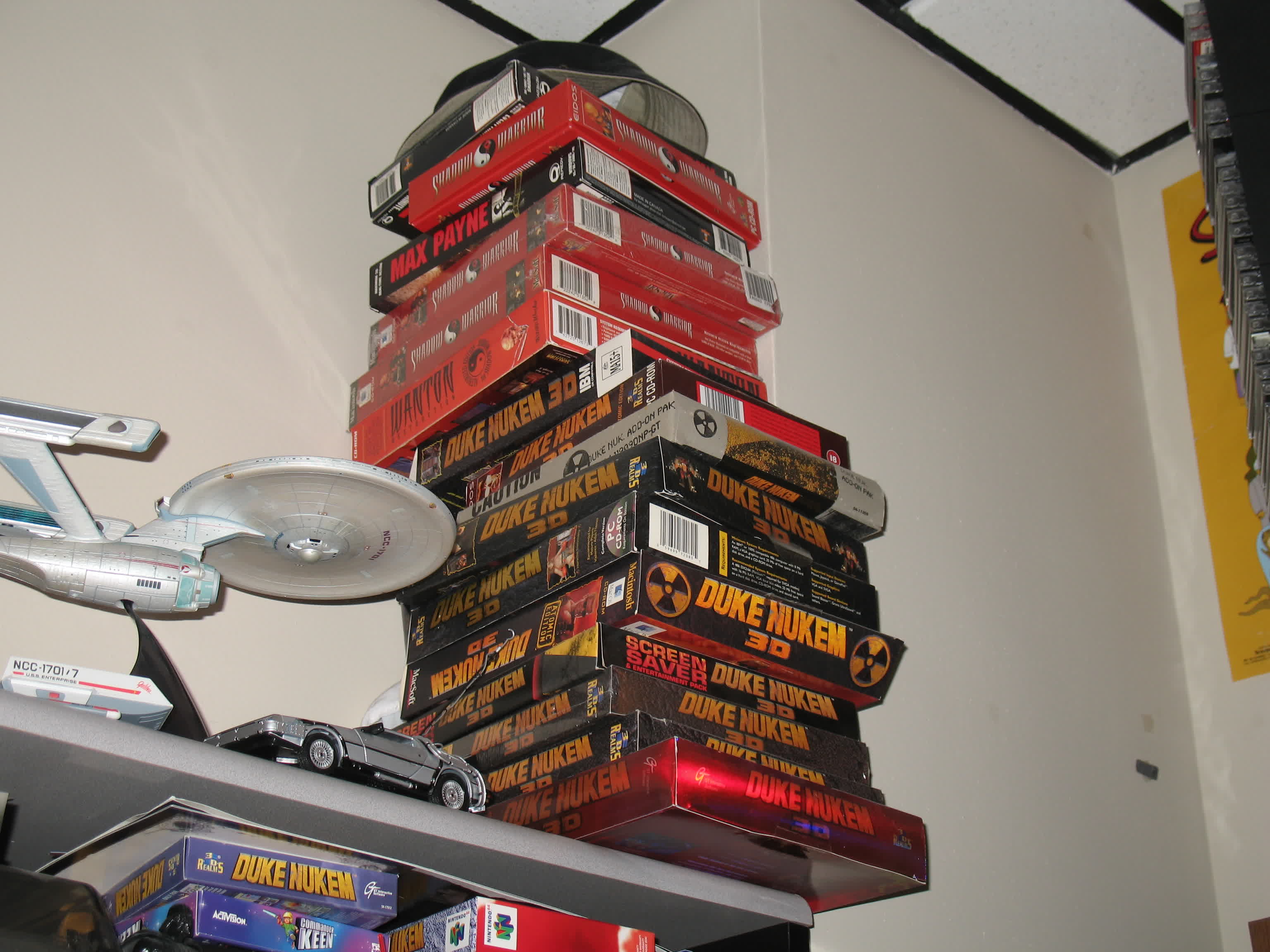
Duke 3D was also notable for having a voiced protagonist. Voice actor Jon St. John lent his talent to the titular character, who shouts one-liners ripped from Army of Darkness, They Live, and other action movies that inspired Duke Nukem.
For a good nostalgia run, you can download Duke Nukem 3D shareware here. The full version is available on Steam, PlayStation, Xbox, and Nintendo Switch as "Duke Nukem 3D: 20th Anniversary World Tour," while the earlier Atomic Edition is playable on Zoom Platform. Many fans recommend playing either edition through source ports such as EDuke32.