
As a follow-up to this week's Zen 3 revisit, we promised an updated look at gaming performance for the Ryzen 7 5800X3D, and that's exactly what this is. We've also included the 5700X3D for good measure, as it was the last version you could realistically buy. Unfortunately, both chips have now reached the end of their production run, which is why our initial AM4 revisit focused instead on the 5600X, 5700X, and 5800XT, parts that remain readily available.
Still, there's a flicker of hope for anyone holding out for a processor like the 5800X3D, even if it's a long shot. During CES 2026, AMD's VP and GM of Ryzen CPU and Radeon, David McAfee, said the company is doing its best to bring the AM4 ecosystem back in some form, responding to ongoing demand from gamers.

Whether that translates into renewed AM4 processor production remains unclear, but if David's comments are any indication, it's at least being considered. Speaking with Tom's Hardware, he suggested that reintroducing AM4 processors could "satisfy the demands of gamers that maybe want that significant upgrade in their AM4 platform without having to rebuild their entire system."
A "significant upgrade" naturally points toward the 5800X3D, though only time will tell if that's what AMD has in mind. For now, the reality is that you can't reasonably buy a 5800X3D at a sensible price – and even if it did return, there's no guarantee it would be affordable. Second-hand units regularly sell for $450 or more, which is difficult to justify considering that was the chip's original MSRP four years ago.

That situation feels even more extreme when you remember that the 5800X3D dropped as low as $270 in late 2023 and could routinely be found for around $320.
Because of that, today's update isn't really about positioning the 5800X3D or 5700X3D as smart upgrade options – or as an escape hatch from high DDR5 pricing. Paying $450 for a 5800X3D simply doesn't add up when you can buy the 9600X for $200 or the 7500F for $150, both of which should deliver similar gaming performance.
Now it's time to dive into the updated CPU benchmark data. We've also refreshed our Core i5-14600K results using a brand-new DDR5-7200 kit and added the Core Ultra 9 285K as another reference point, along with the Ryzen 7 9800X3D. Together, this gives us a clearer view of how gaming CPU performance stacks up across multiple generations.
Test System Specs
| CPU Motherboard Memory |
AMD Ryzen 9000 Series AMD Ryzen 7000 Series |
Gigabyte X670E Master [BIOS F38] G.Skill Trident Z5 RGB 32GB DDR5-6000 CL30 |
| AMD Ryzen 5000 Series | MSI MPG X570S Carbon MAX WiFi [BIOS 7D52v1D1] G.Skill Ripjaws V Series 32GB DDR4-3600 CL14-15-15-35 |
|
| Intel Core Ultra 9 285K Intel Core Ultra 5 225F |
Asus ROG Maximus Z890 Hero [BIOS 2201] G.Skill Trident Z5 CK 32GB DDR5-8200 CL40-52-52-131 CUDIMM |
|
| Intel Core i5-14600K | Asus ROG STRIX Z790-E Gaming WiFi [BIOS 3107] G.Skill Trident Z5 RGB 32GB DDR5-7200 CL34 |
|
| Graphics Card | Asus ROG Astral RTX 5090 OC Edition | |
| ATX Case | MSI Prospect 700R | |
| Power Supply | Kolink Regulator Gold ATX 3.0 1200W | |
| Storage | TeamGroup T-Force Cardea A440 M.2 PCIe Gen4 NVMe SSD 4TB | |
| Operating System | Windows 11 | |
| Display Driver | Nvidia GeForce Game Ready Driver 591.74 WHQL | |
Benchmarks
Rainbow Six Siege X
Starting with Rainbow Six Siege, we see that the 3D V-Cache on these older Zen 3 parts isn't delivering a significant performance uplift in this title. The 5800X3D, for example, was just 8% faster than the 5800XT when using the Medium preset, though that margin increased to 12% with the Ultra+ preset.

Even so, the 5800X3D ended up 4% slower than the Core i5-14600K – a much newer processor. The same is true of the 9600X, where the Zen 3 part was nearly 20% slower in that matchup.
Battlefield 6
Next up is Battlefield 6, where the 5800X3D is able to match the 9600X. That makes it slightly faster than the Core Ultra 5 225F and between 22% and 27% faster than the 5800XT, depending on the quality settings.

The 5700X3D was also 4-6% slower than the 5800X3D, which is very typical. Once again, the 5800X3D was only marginally slower than the 14600K, while trailing the 9800X3D by around 20% – still impressive results from an older AM4 flagship gaming processor.
Arc Raiders
Moving on to Arc Raiders, we see very similar performance from the 5800X3D and 5700X3D when using the Medium and Epic quality presets. Focusing on the Medium results, the 5800X3D matched the 9600X, making it nearly 20% faster than the 14600K and 24% faster than the 225F.

That also put it a massive 47% ahead of the 5800XT, clearly highlighting the impact of 3D V-Cache in this title. We see the same trend with the 9800X3D, and it was particularly impressive to see the 5800X3D finish just 5% behind the Core Ultra 9 285K.
Borderlands 4
The 5800X3D and 5700X3D weren't quite as strong in Borderlands 4, though overall performance remained excellent, delivering over 140 fps in our test. Using the Medium preset, the 5800X3D was 20% faster than the 5800XT. However, it was 8% slower than the 9600X, 11% slower than the 14600K, and 13% slower than the 9800X3D – though that part was GPU-limited.

Marvel Rivals
Marvel Rivals favors memory bandwidth, which leaves the Zen 3 processors somewhat constrained by their DDR4 support. Even so, performance is far from weak, with the 5800X3D reaching 178 fps using Medium settings and the 5700X3D hitting 168 fps.

This made the 5800X3D 13% faster than the 225F and just 5% slower than the 9600X. It was also only 6% behind the 14600K and 8% behind the 285K.
Horizon Zero Dawn Remastered
The Zen 3 X3D parts had no trouble with Horizon Zero Dawn Remastered, delivering over 180 fps. The 5700X3D matched both the 9600X and the 14600K, while the 5800X3D was 5% faster, slotting in just behind the 285K.

As strong as the 5800X3D is, the 9800X3D was still 36% faster, pushing an impressive 266 fps. With the Very High preset enabled, the margins remain similar, though the 5700X3D now sits between the 9600X and 14600K, while the 5800X3D edges slightly ahead of the Core i5.
Cyberpunk 2077: Phantom Liberty
Moving on to Cyberpunk 2077, the 5800X3D and 5700X3D performed extremely well using the Medium preset, outperforming everything except the 9800X3D. That newer part was significantly faster, delivering a 31% uplift over the 5800X3D. Even so, the 5800X3D was 6% faster than the 9600X, 8% faster than the 285K, and 15% faster than the 14600K.

With the Ray Tracing Ultra preset enabled, the results shift slightly. The 5800X3D is now marginally faster than the 14600K and just a few frames behind the 285K, resulting in very similar overall performance.
Counter-Strike 2
In Counter-Strike 2, the 5800X3D and 5700X3D deliver performance comparable to the 285K. Interestingly, this meant the 9600X was 11% faster than the 5800X3D when using the Medium preset, but slightly slower with the Very High preset. Even so, performance overall is strong, and both Zen 3 X3D processors are considerably faster than the 14600K.

Space Marine 2
As many of you will be aware, Space Marine 2 is extremely CPU demanding, which is why the Medium and Ultra results are very similar – the workload is primarily CPU-limited. The 5800X3D holds up well here, matching the 285K with Medium settings and coming in just a few frames behind the 14600K. That still makes it nearly 30% faster than the 5800XT.

The Ultra results tell a similar story. The 5800X3D is again 4 – 5 fps slower than both the 285K and 14600K, while the 5700X3D matches the 9600X, resulting in solid overall performance.
The Last of Us Part II Remastered
Performance in The Last of Us Part II Remastered is also strong, particularly when looking at the 1% lows. The average frame rates of both the 5800X3D and 5700X3D are similar to the 9600X, but the 1% lows are notably better – by up to 20% in the case of the 5800X3D.

Overall performance is right up there with many modern processors, and with 160 fps or more using the maximum in-game quality preset, the experience is just as good on the 5800X3D as it is on the 9800X3D in this title.
Spider-Man 2
From previous testing, we know Spider-Man 2 benefits heavily from increased system memory bandwidth, which means DDR4 does hold the AM4 processors back somewhat. Even so, performance remains very good.

Using the Medium settings, the 5800X3D was 30% faster than the 5800XT, placing it right alongside the 9600X. Performance does fall further behind with the Ultimate Ray Tracing preset, but overall results are still quite strong.
Mafia: The Old Country
Mafia: The Old Country is another modern title that is sensitive to memory bandwidth, once again putting the AM4 processors at a disadvantage, as everything else in this comparison is using DDR5. Even so, performance is respectable, and we still see a healthy uplift over the 5800XT. The 5800X3D was 24% faster using the Medium preset, though that margin shrank to 16% with the more GPU-limited Epic preset.

Assetto Corsa Competizione
Assetto Corsa Competizione isn't particularly sensitive to system memory bandwidth, but it is heavily dependent on cache bandwidth. As a result, the X3D parts perform exceptionally well here, matching or even outperforming modern processors – aside from newer X3D models like the 9800X3D. Using the Medium preset, the 5800X3D was 16% faster than the 14600K and 23% faster than the 285K.

Baldur's Gate 3
Finally, we have Baldur's Gate 3, another title that benefits from the larger L3 cache found on X3D processors. This advantage is clearly reflected in the results, with both the 5700X3D and 5800X3D delivering strong performance despite their age. The 5800X3D was 23% faster than the 9600X using the Medium preset and remained 18% faster with the Ultra preset – excellent results overall.

14 Game Average
Across the 14 games tested, using the Medium settings, the 5800X3D was on average 29% faster than the 5800XT. This shows that 3D V-Cache is still highly effective in modern games. That performance allowed it to match (or slightly edge out) the 14600K by a slim 2% margin, while coming in just 1% slower than the 9600X and 2% slower than the 285K. As a result, it's fair to say all four processors delivered a very similar overall experience.
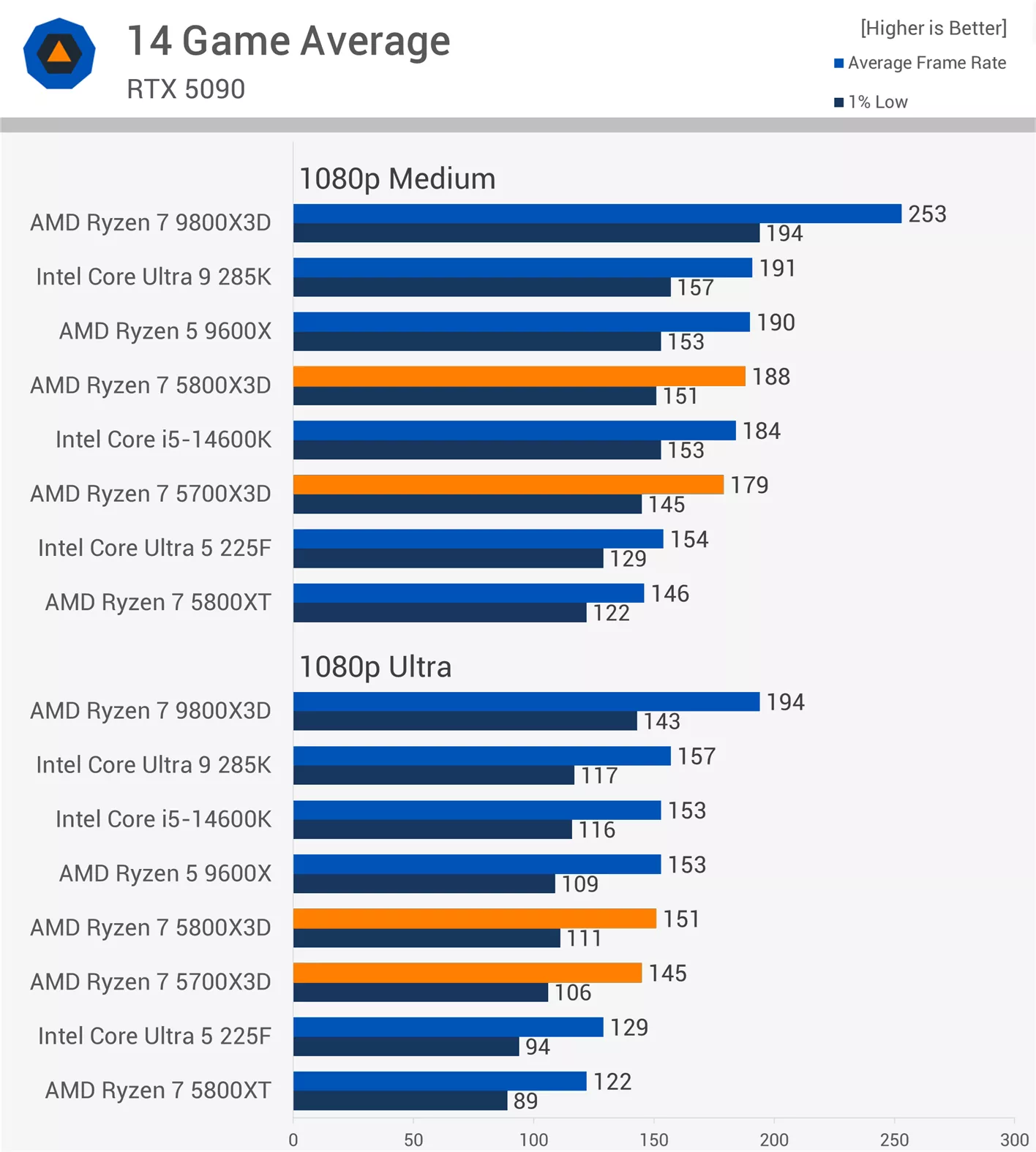
You can also include the 5700X3D in that group, as it was only 5% slower than the 5800X3D, making it 16% faster than Intel's latest budget processor, the 225F. Finally, when compared to the 9800X3D, the current-generation flagship was on average 35% faster than the 5800X3D. That's a sizable uplift, but with the 5800X3D already being very capable, we suspect most owners won't feel especially compelled to upgrade.
Switching to the Ultra preset does knock these older Zen 3 processors down slightly, but the overall picture remains much the same. The 5800X3D once again matched the 14600K and 9600X, making it only marginally slower than the 285K.
The biggest change appears when looking at the 9800X3D, which becomes more GPU-limited, reducing its lead over the 5800X3D from the 35% seen with the Medium settings to 28%.
The 5800X3D's Staying Power
Over the past few years, the Ryzen 7 5800X3D has consistently delivered gaming performance on par with AMD's modern 6-core processors, including the 7600X and 9600X, and our latest testing confirms this still holds true.
That's good news for anyone running a 5700X3D or 5800X3D, as it means you're still getting excellent performance that's comparable to modern CPUs. Realistically, the only meaningful upgrades would be the 7800X3D or 9800X3D, and given the costs involved, those upgrades generally don't make much sense.

Another factor helping these Zen 3 X3D processors age so well is the Windows 11 24H2 update, which we touched on in our previous Zen 3 revisit, but can revisit again here. This isn't an apples-to-apples comparison, and we never tested the 5800X3D on 23H2 directly against 24H2. However, we do know the 24H2 update boosted performance across all Ryzen processors thanks to branch prediction optimizations.
As supporting evidence, we can look back at benchmarks from our 14th-gen Core series review, which included both the Core i5-14600K and the 5800X3D. That two-year-old data was gathered using Windows 11 21H2 (which performs the same as 23H2) and across the 12 games tested, the 14600K was on average 9% faster than the 5800X3D when paired with an RTX 4090.

Fast-forward to today, and our updated results show the 5800X3D and 14600K running neck and neck. That lines up well with the Windows 11 24H2 update delivering roughly a 10% performance uplift for Ryzen processors, something other outlets have also independently confirmed.
Looking further back, one concern some people had when the 5800X3D first launched was that it wouldn't age particularly well, either because it was limited to 8 cores or because future games would outgrow the 64 MB 3D V-Cache. The exact reasoning varied, but we do remember claims suggesting the 3D V-Cache was only useful in smaller games that could fit entirely within the cache. It was an odd argument, yet one that came up frequently at the time.

Regardless of the specifics, the general idea was that the benefits of 3D V-Cache were being overstated and that future titles would eventually expose its limitations. Looking back now, that simply hasn't happened.
Our original Ryzen 7 5800X3D review, published four years ago, featured eight games tested at 1080p using the RTX 3090 Ti. In that testing, the 5800X3D – using the same DDR4-3200 memory as the 5800X – was 23% faster on average, a very solid uplift.

Today, using the same memory configuration, the 5800X3D is on average 29% faster than the 5800XT with the Medium settings and 24% faster with the Ultra settings. Four years later, very little has changed in that comparison, and it's worth noting the 5800XT is only around 3% faster than the original 5800X on average.
Based on all of this, we think the hype surrounding the 5800X3D for PC gamers was fully justified, and as we approach the four-year mark, its longevity has been thoroughly validated.

The Core i9-12900K, which launched five months earlier, required expensive DDR5 memory just to match the 5800X3D in our 40-game benchmark, while costing well over $600 for the processor alone. To be fair, Intel's Core i9 offered much stronger productivity performance and was the more well-rounded CPU overall. But purely for gaming, the 5800X3D was king. Fingers crossed AMD resurrects this product or a variation of it at an attractive price point.