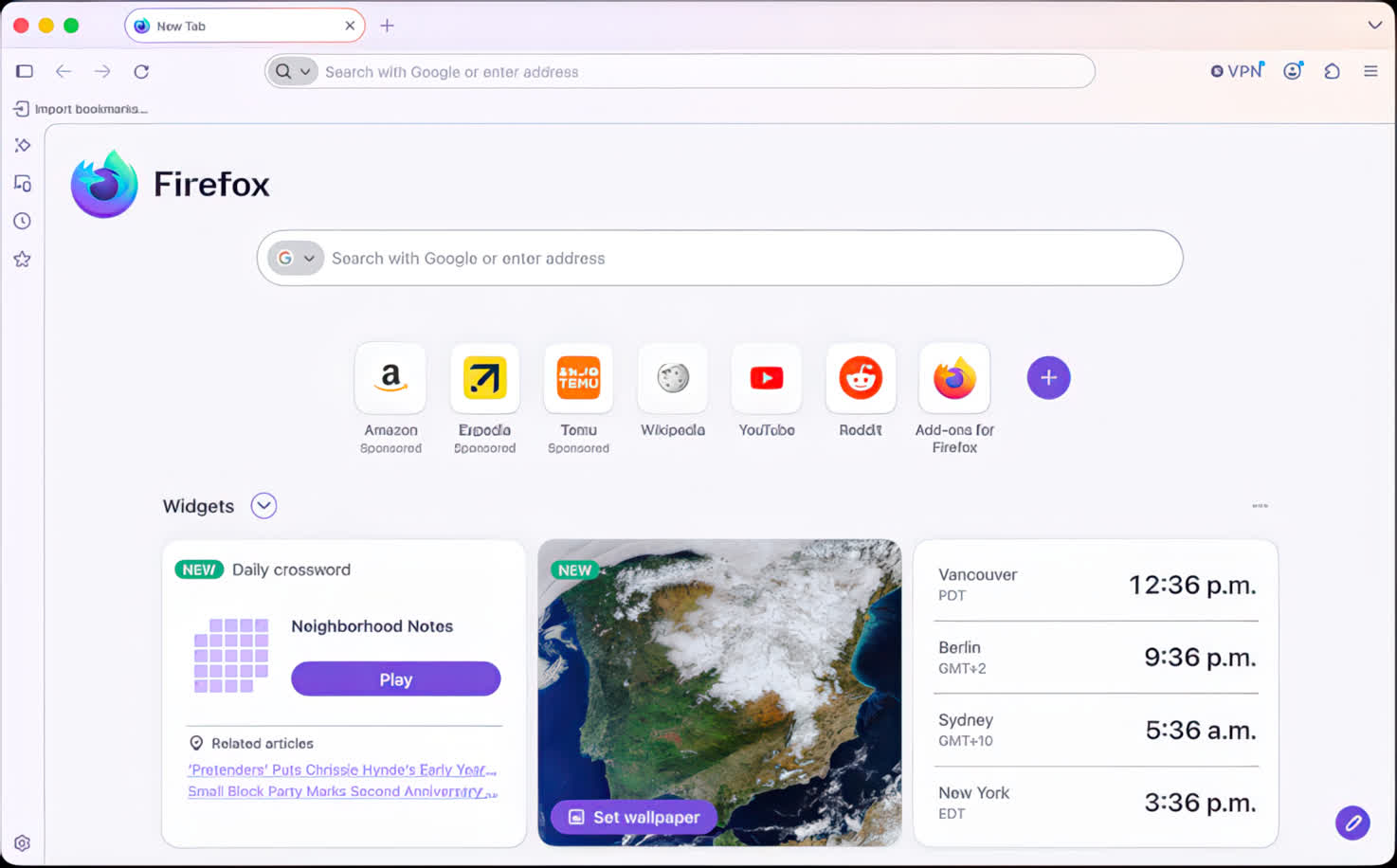
Firefox's has been reimagined in 2026 to be fast, modern and inviting the first time you run it and every day after. We've always had your back on privacy, and still do. We think the browser should be a piece of software you can rely on to have your back, pleasant to look at and working seamlessly with the web.
We're living in a frenetic time, where people are dealing with tough changes in our daily lives and hard to solve problems are popping up everywhere. We think the browser should be a piece of software you can rely on to have your back, pleasant to look at and working seamlessly with the web.
We're also on a mission to save you time, whether that's by making pages load faster, using less memory, or by streamlining everyday use of the browser. Good design is invisible. So if things just work, you don't really think about it. But a ton of thought has been put into the flow. Our users who have tried the new Firefox have said, "the fact that I was using a new web browser slipped into the background of my consciousness." And that's just what we were going for.
A sleek, clean Firefox design backed by research
Going into the Firefox redesign, our team studied how people interact with the browser, observing their patterns and behaviors. We listened to feedback and gathered ideas from regular people who just want to have an easier experience on the web. We obsessed over distractions, extra clicks and wasted time. The resulting new design is simple, modern and fast and delivers a beautiful experience to support what people do most in Firefox.
Bright and buoyant throughout
The fresh new Firefox is easy on the eyes, bright and buoyant on screens of all sizes --- computers, phones and tablets. A new icon set, crisp typography and thoughtful spacing throughout all reflect a modern aesthetic.
Streamlined toolbar and menus
The toolbar is naturally where you start every web visit. It's the place where you type a URL to go somewhere online. After web page content, it's what you look at most in Firefox. The new toolbar is simplified and clutter-free so you get to the good stuff effortlessly.
Menus are where key Firefox actions and commands live. We've consolidated extra menus to reduce clutter and be more intuitive through the three bars menu in the upper right or by right-clicking to activate it on your computer screen. The new look reorganized and streamlined our menus to put the best actions quickly at your fingertips.
When privacy protections are engaged in Firefox, the shield icon in the toolbar glows subtly indicating that we're working behind the scenes to protect you from nosy trackers. Fun fact: Firefox has blocked more than 6 trillion --- that's trillion with a T --- trackers since we rolled out enhanced tracking protection, stopping thousands of companies from viewing your online activity.. We're talking about tracking cookies, social media trackers, fingerprinters, cryptominers and more. Go ahead and click on the shield to see who and what Firefox is blocking... you might be surprised by what you find out.
A new look for tabs
Based on our research, we found out that more than half of you have 4+ tabs open all the time, and some of you have more, a lot more. And we feel that! Tab as much as you like, friends. Tabs got a makeover so they are now gently curved and float above the toolbar. It's an exciting change that also serves as a reminder that tabs aren't stationary. So grab those tabs, move them around and organize them as you like. Tabs also got a glow-up to be a touch brighter when active.
Shhhhhh.... notifications
No one likes to be interrupted when they're in the flow, but if you must be alerted to something, at least it can look good. We've updated notifications and alerts of all kinds in Firefox to take up less space for less jarring interruptions. Plus, non-essential alerts and messages have been removed altogether. Media autoplay is turned off by default, so you won't be interrupted by a random video blasting unexpectedly. Spotting a noisy tab is easy, and unmuting/muting takes just a quick click on the tab itself.
Expanded privacy protections
Mozilla makes it our mission to put your privacy and security first in the technology we develop. Our goal is for you to worry less every time you go online. The latest Firefox release comes to you with next-level security and privacy that you've come to expect from us.
The best private browsing mode out there
All browsers have a private browsing mode, but none match Firefox. The popular Total Cookie Protection moves from the optional strict setting to always-on in private browsing. This feature maintains a separate "cookie jar" for each website you visit while browsing privately. Any time a site deposits a cookie, Firefox locks it up in its own cookie jar so that it can't be shared with any other website.
An even better Firefox for iOS and Android
The fresh new look covers Firefox everywhere, from desktop browsers to Android and iOS mobile devices. The iOS experience is optimized for iPhone and iPad, with key actions now taking fewer steps for quicker searches, navigation and tab viewing. With refinements in iconography and menu names, the whole browsing experience is more cohesive and harmonious across every platform.
Shape Up Your Floats
CSS Shapes lets a floated element sculpt the flow of content around it beyond the classic rectangular bounding box we've been constrained to. For instance, in the above screenshot and linked demo, the text is wrapping to the shape of the grapes vs the image's border. There are properties for basic shapes all the way up to complex polygons.
You can learn more in Josh Marinacci's post on the new CSS Shapes tooling from yesterday.
Variable Fonts Are Here
No punny title, I'm just excited! OpenType Font Variations allow a single font file to contain multiple instances of the same font, encoding the differences between instances. In addition to being in one file, font creators can expose any number of variation axes that give developers fine-grained control on how a font is rendered. These can be standard variations like font weight (font weight 536 looks right? no problem!) or things that were never previously available via CSS (x-height! serif-size!). In addition to the candy-store possibilities for typography nerds, being able to serve a single file with multiple variants is a major page weight savings. Dan Callahan goes much deeper on the grooviness to be found and how Firefox makes it easy to tweak these new custom values.
Devtools Commands
The Developer Toolbar was an alternate command repl input in the Firefox Developer tools, apart from the Web Console. I say "was" because as of Firefox 62, it has been removed. It was always a bit hard to find and not as well-advertised as it could be, but did encapsulate some powerful commands. Most of these commands have been progressively migrated elsewhere in the devtools, and this is wrapped up in Firefox 62, so we've removed the toolbar altogether.
One of the last commands to be migrated is screenshot, which is a power-user version of the "take a screenshot" button available in the devtools UI. The screenshot command is now available as :screenshot in the Web Console. For example, have you ever needed a high-res screenshot of a page for print? You can specify a higher pixel density for a screenshot via the command: :screenshot --dpr 4
There are a bunch of other options as well, such as specifying output filenames, capture delays, and selector-cropped screenshots. Eric Meyer wrote a great primer on the power of :screenshot on his blog, and it will change your page capture game.
What's New
Version 157.0, first offered to Release channel users on September 29, 2026
New
- Firefox's biggest visual refresh in years is now available, with a modernized look across the browser toolbars, sidebar, menus and individual features, built with our updated design system. It also includes:
- New built-in themes with light and dark versions, to personalize the look of Firefox in one click.
- A new compact mode that reduces toolbar and tab spacing to leave more room for web content, useful on smaller screens and in split-screen layouts.
- WebRTC video calls can now use hardware AV1 decoding on devices that support it, instead of always decoding AV1 video in software.
- Firefox now shows a warning in the site information panel (the shield icon in the address bar) and in Settings when it has been set up to record its encryption keys, which could let other software on the computer read encrypted web traffic.
- Firefox Suggest now offers suggestions in the address bar in Austria, Belgium, Czech Republic, Denmark, Finland, Hungary, Ireland, Luxembourg, Netherlands, Norway, Poland, Portugal, Slovakia, Spain, Sweden, and Switzerland. They can be controlled in the Firefox Suggest settings. Learn more.
Fixed
- Fixed video from phones and tablets appearing sideways or upside down in WebRTC calls.
- Fixed the address bar searching for the typed text instead of opening the selected suggestion when a page was still loading, such as shortly after Firefox started.
- Fixed some HDR videos encoded in 8-bit color formats looking dull and gray on Windows instead of displaying in HDR.
- Improved audio and video synchronization when repeatedly changing the playback speed of videos, for example on YouTube.
- Fixed the Vertical Tabs sidebar not reappearing when the cursor moves to the edge of the screen in full screen mode.
- Fixed an issue on Windows where making a video full screen would leave the Windows taskbar showing over the video.
- Various security fixes.
Changed
- Pressing Tab now moves focus straight to the text field of the address bar and search bar instead of stopping on the search engine button first. The button can still be reached with Shift+Tab.
- Amazon is no longer included as a built-in search engine. It can still be added as a custom search engine in the search settings. Learn more.
- The updated sidebar is now enabled for everyone. Anyone still using the previous sidebar will keep a similar layout, with the panel switcher at the top of the sidebar. Additionally, the "Show sidebar" option has been removed from Settings.
- While we continue to refine the new design, the previous sidebar version can still be restored by setting sidebar.revamp to false in about:config. This also turns off vertical tabs. The preference will remain available until the end of 2027.
- Web page alert(), confirm() and prompt() dialogs, the color and date pickers, and form autocomplete drop-downs now match the page's light or dark color scheme.
Previous Release Notes:
Version 156.0, first offered to Release channel users on September 15, 2026
New
- Firefox on macOS can now be set to open automatically when the computer starts up, from the Startup section of Settings.
- Localized Wikipedia and occasional sponsored suggestions in the address bar are now available in France, Germany, and Italy. These suggestions can be turned off in Firefox Suggest settings.
Fixed
- Fixed an issue where dragging an image to a new position in a rich-text editor could replace it with a long line of text instead of moving it.
- Fixed high-sample-rate FLAC audio in MP4 failing to play on sites such as Bilibili.
- Fixed subtitles not appearing in the Picture-in-Picture window when they are turned on in the video player after the window has already opened.
- Fixed bookmarks moving out of their folder when the folder and the bookmarks inside it were selected and dragged together in the Bookmarks sidebar.
- Fixed the find bar becoming permanently unavailable in a tab after reversing the panes in Split View.
- Fixed some sites failing to load when DNS over HTTPS is enabled and the site does not support HTTPS.
- Fixed Firefox losing all network connectivity for some users with the built-in VPN enabled.
- Fixed an issue on Windows where Firefox could block an auto-hiding taskbar from showing.
- Various security fixes.
Changed
- Firefox's built-in PDF viewer now starts up to 45% faster.
- Improved memory and CPU usage when Firefox displays large JPEG images scaled down to fit a page.
- On Windows devices with ARM64 processors, WebRTC video calls may now use hardware H264 decoding instead of falling back to software.