Editor's take: Amazon's Alexa+ hasn't attracted much attention in the year since its unveiling, overshadowed by rival AI assistants from OpenAI, Microsoft, and Google. The company appears to be positioning its new podcast-creation feature as a killer app to help differentiate it from the competition.
Prime subscribers in the US can now ask Alexa to create audio podcasts on virtually any topic. To provide the AI with reliable sources, Amazon has partnered with The Washington Post (owned by CEO Jeff Bezos), Reuters, the Associated Press, TIME, Forbes, Business Insider, Politico, USA Today, Vox, and more than 200 local outlets across the US.
After users specify a topic, Alexa generates a preliminary overview for review. Users can then set the preferred length and conversational style, and the assistant produces a podcast episode with two AI-generated host voices within minutes.
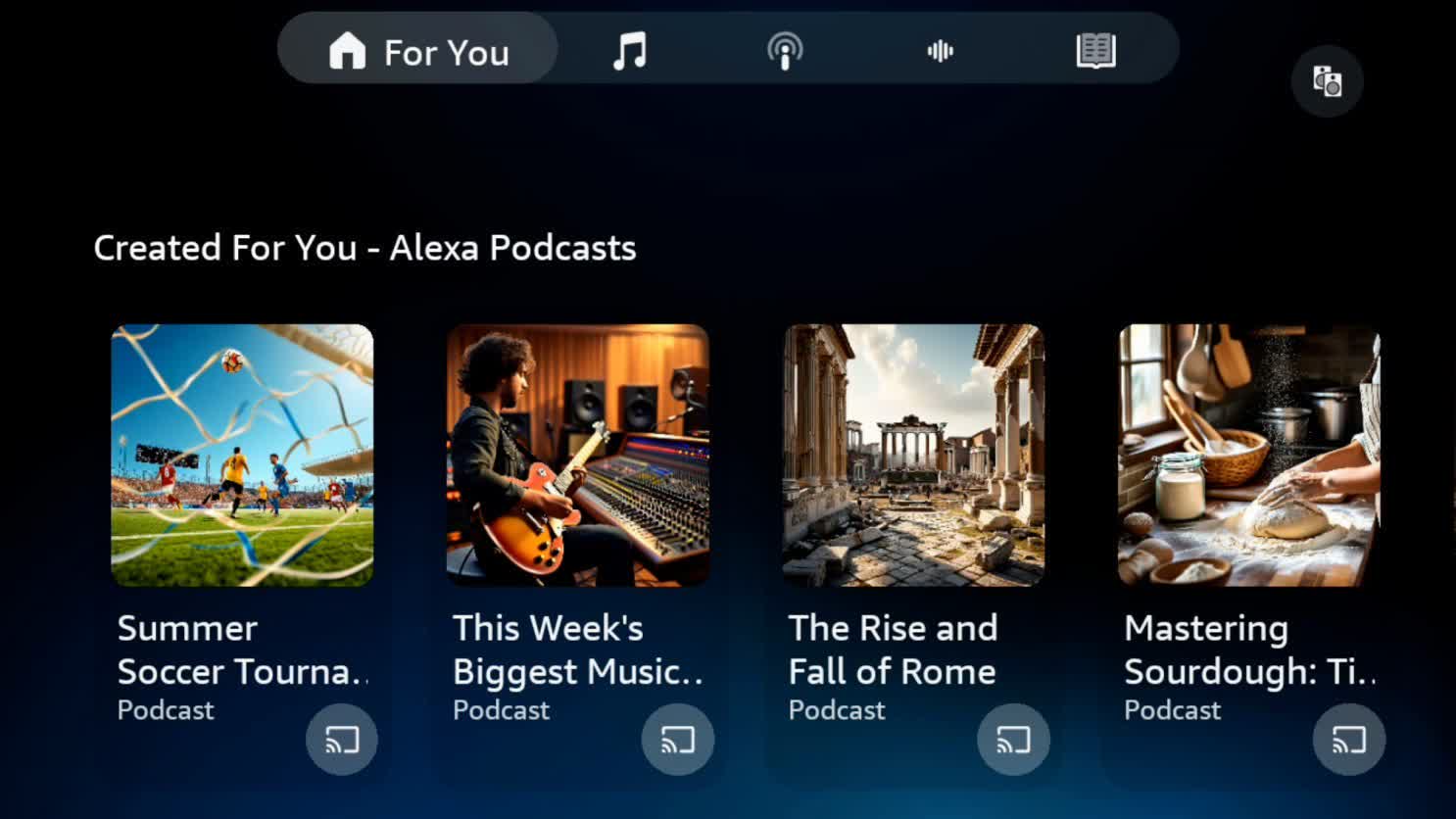
Available topics include the latest news, the outcomes of recent sporting events, popular music, chatter about recent movies, history, tourism, various hobbies, and professional advice.
Three brief samples provide a glimpse of how the hosts discuss sports, the music industry, and ancient Roman history. It remains to be seen how they might compare to human-made podcasts on those topics.
Sourcing content from established media outlets doesn't necessarily guarantee accuracy, however. In late 2024 and early 2025, Apple's AI-generated news summaries through Siri hallucinated and jumbled facts so badly that the BBC strongly advised users against relying on the feature.

Amazon initially unveiled Alexa+ in early 2025, bundling it free with Prime memberships. The upgrade brought large language models from Amazon Bedrock into Alexa, enabling it to handle complex, multi-step tasks. Amazon marketed the assistant as a new way to place orders, organize calendars, and track user preferences. Weeks after launch, however, Reuters found little evidence that anyone was actually using it. Subscribers later complained when Amazon automatically upgraded their standard Alexa to the LLM-based version without warning.
Public reception to AI hasn't improved recently, even among younger, more tech-savvy audiences. Despite widespread reports about endemic AI usage in schools, recent graduates booed graduation speakers for praising the technology on two separate occasions in the past week. Anti-AI sentiment may be mounting due to employee working conditions, the growth and impact of data centers, the proliferation of AI slop, and other factors.