Recap: Windows 10 technically reached end-of-life last October, and analysts say users have been migrating to Windows 11 in large numbers – but potentially millions are stubbornly holding on to the older OS. Microsoft appears to have quietly acknowledged that reality by tacking on another year to Windows 10's critical security support window.
Microsoft's support page explaining how to continue receiving security updates on Windows 10 now states that the company will continue providing patches through October 12, 2027 – a change made without a formal announcement. The update gives Windows 10 users exactly one additional year to decide whether to upgrade to Windows 11, accept the risks of an unsupported OS, or look elsewhere.
Official support for Windows 10 ended on October 14, 2025, but Microsoft's Extended Security Updates (ESU) program gives some users a way to keep receiving the most critical security patches.
Non-business devices with Microsoft accounts can either redeem 1,000 Microsoft Rewards points, make a one-time $30 purchase, or sync their PC settings to their Microsoft account via the Windows Backup app for free access. Devices in the European Economic Area gained free access to ESU after Euroconsumers, an international consumer advocacy organization, pushed back on Microsoft's original enrollment requirements.
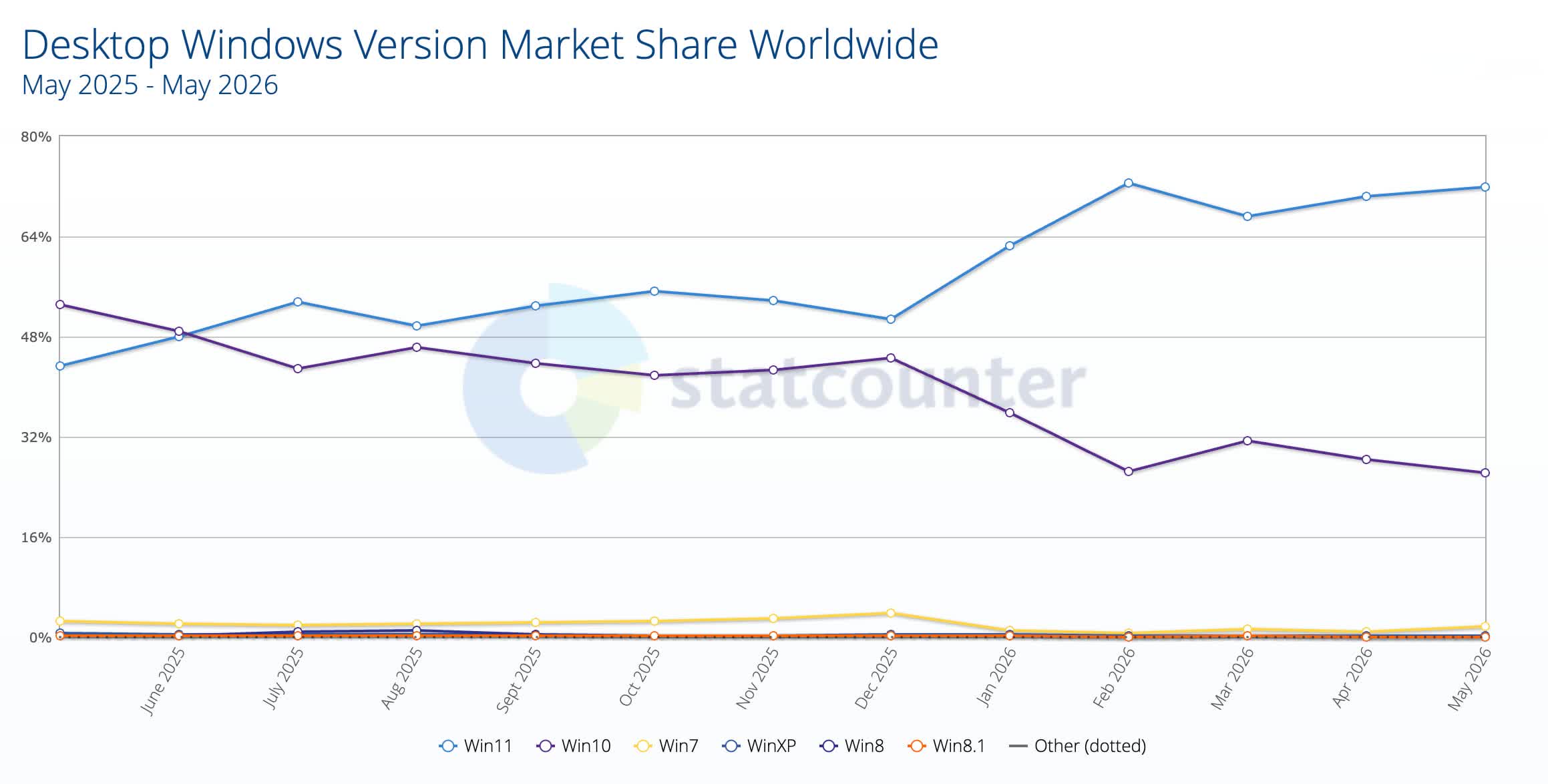
The extension is likely an acknowledgment of Windows 10's enduring popularity. Windows 11 has surged since its predecessor's end-of-life, reaching a 72.57% global desktop market share by February 2026, and continues to widen the gap, but many users consider its upgrades insufficient or are put off by its rapid embrace of AI features.
Recent Windows 11 updates, such as one that broke the Recycle Bin, have drawn widespread criticism, and benchmarks have rated its File Explorer as a step back from Windows 10's.
Around one billion PCs were still running Windows 10 at the end of 2025, according to figures shared during Dell's quarterly earnings call, and hundreds of millions of those cannot meet Windows 11's hardware requirements. Microsoft's insistence on TPM 2.0 has left millions of perfectly functional machines out in the cold, pushing many users to look elsewhere.
For example, 0patch has pledged to provide third-party Windows 10 security patches until 2030, though they may only be a stopgap. Meanwhile, Commodore has pitched its Linux-based Vision OS 3.0 as a free escape route for disgruntled Windows 10 users, and the End of 10 initiative is working to ease the transition to Linux for those with hardware that can't run Windows 11.
France has gone further still, announcing that it will migrate 2.5 million government workstations from Windows to Linux as part of a broader digital sovereignty push. Valve's SteamOS is also making inroads among gaming-focused users.
The RAM crisis may have also factored into Microsoft's decision to extend the ESU program, with new PC prices pushed sharply higher by an ongoing memory shortage. AI giants, Microsoft among them, are racing to build out data centers at scale, diverting much of the world's DRAM and NAND supply and making consumer electronics increasingly expensive.