
In brief: Microsoft has confirmed that WMIC will soon be completely eradicated from supported Windows editions. The command-line interface offered powerful ways to interact with a computer's hardware and the broader Windows software ecosystem, but it's now being phased out in favor of more efficient alternatives.
Microsoft recently released a new Insider Preview Build of Windows 11, giving unpaid beta testers an early look at features headed to the stable release. Tucked into the changelog for Preview Build 26100.9267/26200.9267 is confirmation that this marks the beginning of the end for WMIC.
Redmond first flagged WMIC as deprecated in 2016, listing it among the deprecated features of Windows Server 2012. According to the latest build's changelog, WMIC will no longer be included in Windows 11 24H2 and 25H2 starting in August 2026. The tool has been available as an "on-demand" download in Windows 11 since 2022, but it's now set to disappear entirely – even from the optional features users could install later.
The underlying Windows Management Instrumentation (WMI) framework has shipped with every Windows release since Windows 2000, and was even offered as a manual download for Windows NT 4.0, Windows 95, and Windows 98.
WMIC itself arrived later, debuting with Windows XP and Windows Server 2003 as a command-line front end for querying and managing a system through WMI – and it's WMI, not WMIC, that "is apparently not going anywhere anytime soon."
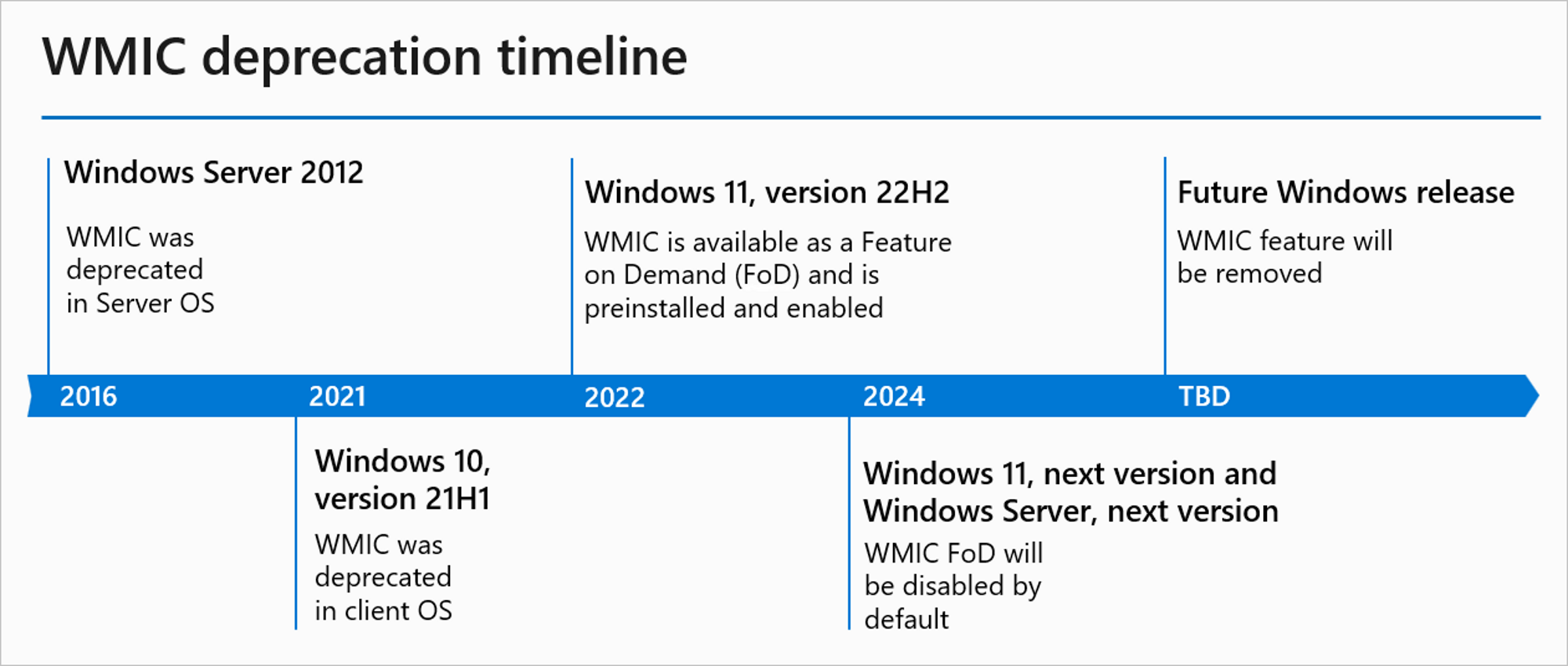
A few years ago, Microsoft explained that WMIC was being deprecated because PowerShell now offers the same functionality through a more efficient, more powerful command-line environment. The company has "heavily" invested in PowerShell, and wants legacy tools like WMIC to disappear from Windows for good.
PowerShell includes several "cmdlets" for interacting with WMI, and Microsoft says removing deprecated components like WMIC will reduce the complexity of the Windows ecosystem, improving both productivity and security for customers. Or so Microsoft says.
In practice, WMIC was heavily relied upon by developers and power users to manage and customize generations of the Windows operating system. Thanks to WMI and WMIC, users could easily pull information from a computer's hardware components, check the Windows product key, and much more.
Microsoft is now advising anyone still relying on WMIC scripts to migrate to PowerShell. Developers, meanwhile, are being pointed toward interacting with WMI "programmatically" through Win32 APIs, using supported languages like C++, .NET, or VBScript. Anything but WMIC, in other words.