
AMD released its Zen 5 architecture in late 2024, and it quickly earned meme status as "Zen 5%." The performance uplift over the previous generation for general desktop use and gaming was extremely underwhelming, so much so that we labeled it a flop and not worth buying until it reached current Zen 4 pricing.
However, there was one Zen 5 processor released three months after the initial wave that did receive a lot of fanfare, and that processor was, of course, the Ryzen 7 9800X3D. But if we're honest, even the 9800X3D was fairly underwhelming. After all, it was just 7% faster than the 7800X3D, which isn't nothing, but the MSRP was also increased by 7% to $480, making it a bit of a buzzkill.

Worse still, leading up to the 9800X3D release, the 7800X3D could regularly be had for $420, with pricing going as low as $340, making the 9800X3D around 14% more expensive than typical 7800X3D pricing.
So in terms of value, the 9800X3D wasn't amazing. However, as the world's fastest gaming CPU, demand was high, and as a result it was a huge success for AMD. Currently, it can be found at or just below the $480 MSRP, and last year we even saw temporary sale prices as low as $440. With demand remaining strong, pricing has also stayed high.

Now, leading up to CES 2026 early this year, rumors suggested AMD was working on a special version of the 9800X3D that clocked higher and therefore delivered better performance. This model would be known as the 9850X3D. As it turns out, the rumors were correct. AMD did announce the 9850X3D at CES, and today we can finally show you what it has to offer.
X3D or KS-Class?
We have to admit that when we first heard about this part, our minds immediately went to Intel's KS CPUs, like the 14900KS. If you're an extreme overclocker – and let's be honest, you almost certainly aren't – the 14900KS might be interesting. For everyone else who isn't cooling their CPU with liquid nitrogen, it was simply a more absurd version of an already absurd product.

Out of the box, the 14900K was already a ridiculously power-hungry processor that ran hot as a result, and it was quite expensive at $620, though today it can be found for around $470. Selling a binned version that clocked just 3% higher while using over 30% more power for a 17% price increase was widely viewed as little more than a money grab.
So is AMD doing the same thing with the 9850X3D?
| Ryzen 7800X3D | Ryzen 9700X | Ryzen 9800X3D | Ryzen 9850X3D | |
|---|---|---|---|---|
| Price MSRP | $450 | $360 | $480 | $500 |
| Release Date | Apr 2023 | Aug 2024 | Nov 2024 | Jan 2025 |
| Cores / Threads | 8C / 16T | |||
| Base Clock | 4.2 GHz | 3.8 GHz | 4.7 GHz | |
| Boost Clock | 5.0 GHz | 5.5 GHz | 5.2 GHz | 5.6 GHz |
| L3 Cache (Total) | 96 MB | 32 MB | 96 MB | |
| Box Cooler | N/A | |||
| Chiplets | 1 x CCD, 1 x I/OD | |||
| Core Config | 1 x 8 | |||
| TDP | 120 W | 65 W | 120 W | |
Is this just a silly version of the 9800X3D? That's what we're here to find out, but at least on paper, things look very sensible. First, we're looking at an 8% increase in boost clocks – not massive, but certainly better than 3%. Interestingly, the TDP has remained the same at 120 W, which is something we'll be examining closely.
Most important of all, the price is not ridiculous. In fact, it appears very reasonable at $500, just $20 more than the 9800X3D, or a modest 4% premium.
So let's move on and see how the 9850X3D performs, and whether it justifies that very small premium.
Benchmarks
Cinebench 2024 - Screen Recording
Let's first look at how the 9850X3D behaves under load and compare it side by side with the 9800X3D. Using Cinebench 2024's multi-core test, we found that the 9850X3D clocked an average of 5.32 GHz – just a 2% increase over the 9800X3D. For this small gain, core voltage increased by 12% according to the motherboard.

However, when measuring power draw using our ElmorLabs PMD2 external power meter, we observed a substantial 27% increase across the EPS power connectors. Average power consumption jumped from 128 watts with the 9800X3D to 162 watts with the 9850X3D. Given this increase, it's a little odd that AMD chose the same TDP rating for both parts, as the newer model clearly draws more power.
That said, power draw from the 9850X3D is still far from extreme. It's certainly high for an 8-core processor, but compared to CPUs like the Core Ultra 9 285K or the 14900K, it uses significantly less power.
When comparing core clock speeds during the single-core test, we see the 9850X3D boosting up to 5.62 GHz – an 8% increase over the 5.22 GHz achieved by the 9800X3D. As advertised, the newer model does indeed clock up to 8% higher.
Cinebench 2024
Here's a look at multi-core performance in Cinebench. As the modest 2% increase in clock frequency suggested, the performance uplift is almost nonexistent, amounting to just a 2% gain in this example.

For gaming, however, we should see better results. The 9850X3D can be up to 7% faster in lighter workloads, so actual gains will depend on how CPU-heavy each game is.

7-Zip File Manager
We won't spend much time on productivity benchmarks, as the 9850X3D isn't really designed for that kind of workload. As further evidence, in the 7-Zip compression test the 9850X3D was only 1.5% faster than the 9800X3D, while decompression performance improved by just 4%.


Gaming Benchmarks
Rainbow Six Siege X
Jumping into the gaming benchmarks, we'll start with Rainbow Six Siege. Using the Medium preset, the 9850X3D was 5% faster than the 9800X3D, making it 16% faster than the 14900K and 18% faster than the 7800X3D. Switching to the Ultra+ preset causes the higher-end CPUs to become GPU-bound, so the 9850X3D offers no meaningful gains here.

Battlefield 6
Performance gains in Battlefield 6 are even better – at least with the Medium preset. In this case, the 9850X3D is 7% faster than the original model, making it 21% faster than the 14900K and 22% faster than the 285K. However, switching to the Overkill preset pushes the AM5 X3D processors into GPU-limited territory, capping performance at around 200 fps.

Arc Raiders
Next up is Arc Raiders. In this test, the 9850X3D is just 3% faster using the Medium preset and only 1% faster with the Epic preset. Even so, it still delivers a commanding lead over competing Intel CPUs – beating the 14900K by 42% with Medium settings and outperforming the 285K by 47%.

Borderlands 4
Moving on to Borderlands 4, even the Medium-quality results are largely GPU-limited, despite testing with the RTX 5090. Borderlands 4 isn't exactly known for great optimization, so given these GPU-bound results, the 9850X3D offers no meaningful advantage over the other high-end CPUs tested.

Marvel Rivals
Testing with Marvel Rivals shows a 6% increase for the new 9850X3D over its predecessor when using Medium quality settings. With the Ultra preset, however, performance becomes heavily GPU-limited at 160 fps. Looking back at the Medium results, AMD's updated flagship is now 20% faster than the 14900K and 37% faster than the 285K.

Baldur's Gate 3
The X3D processors are Baldur's Gate 3 specialists, and the data clearly shows why. The older 7800X3D is 33% faster than the 14900K, which is impressive, but not as striking as the 60% lead held by the 9800X3D. Now we have the 9850X3D, but it improves on the already strong result of the 9800X3D by just 3%. Performance is still excellent, though the uplift over its predecessor is modest.

Cyberpunk 2077: Phantom Liberty
Another title where 3D V-Cache processors shine is Cyberpunk 2077: Phantom Liberty. Here, the 9850X3D is 5% faster than the 9800X3D, making it 33% faster than the 14900K and 53% faster than the 285K.

However, for those focused on ray tracing performance, Intel's 14900K matches the 9850X3D in this test. That result is noteworthy and can't simply be explained by GPU limitations, as the 9850X3D still outperforms the 285K by 11%.
Counter-Strike 2
Counter-Strike 2 runs exceptionally well on the 9850X3D. While it's only 6% faster than the 9800X3D, that still makes it 16% faster than the 7800X3D and a massive 50% faster than the 14900K. Using the Very High preset shifts the workload more toward the GPU, reducing the advantage of the X3D parts, and in this case the 9850X3D is just 3% faster than the 9800X3D.

Space Marine 2
Space Marine 2 benefits heavily from CPU performance, so it's no surprise the 9850X3D delivers a small but consistent uplift here. Frame rates increase by 5% when using either the Medium or Ultra presets. As a result, the 9850X3D is 35% faster than the 14900K and 43% faster than the 285K.

Mafia: The Old Country
Mafia: The Old Country is largely GPU-limited, even with the Medium preset. Unsurprisingly, the 9850X3D offers little additional performance here, essentially matching the 9800X3D.

Assetto Corsa Competizione
Like Baldur's Gate 3, Assetto Corsa Competizione performs extremely well on 3D V-Cache processors. As a lightly threaded title, it allows the 9850X3D to post its biggest gains, boosting performance by a full 7%. That makes it 21% faster than the 7800X3D and nearly 60% faster than the 14900K, while the 285K trails far behind with a 93% deficit.

Spider-Man 2
We expected to see a 6 – 7% improvement in Spider-Man 2, but using the Medium preset the 9850X3D is only 1.5% faster, offering no meaningful performance gain. That said, with the Ultimate ray tracing preset enabled, we do see a 6% uplift – enough for the 9850X3D to narrowly overtake the 14900K. Once again, this highlights how well the 14900K performs with ray tracing enabled, easily outperforming parts like the 7800X3D.

Horizon Zero Dawn Remastered
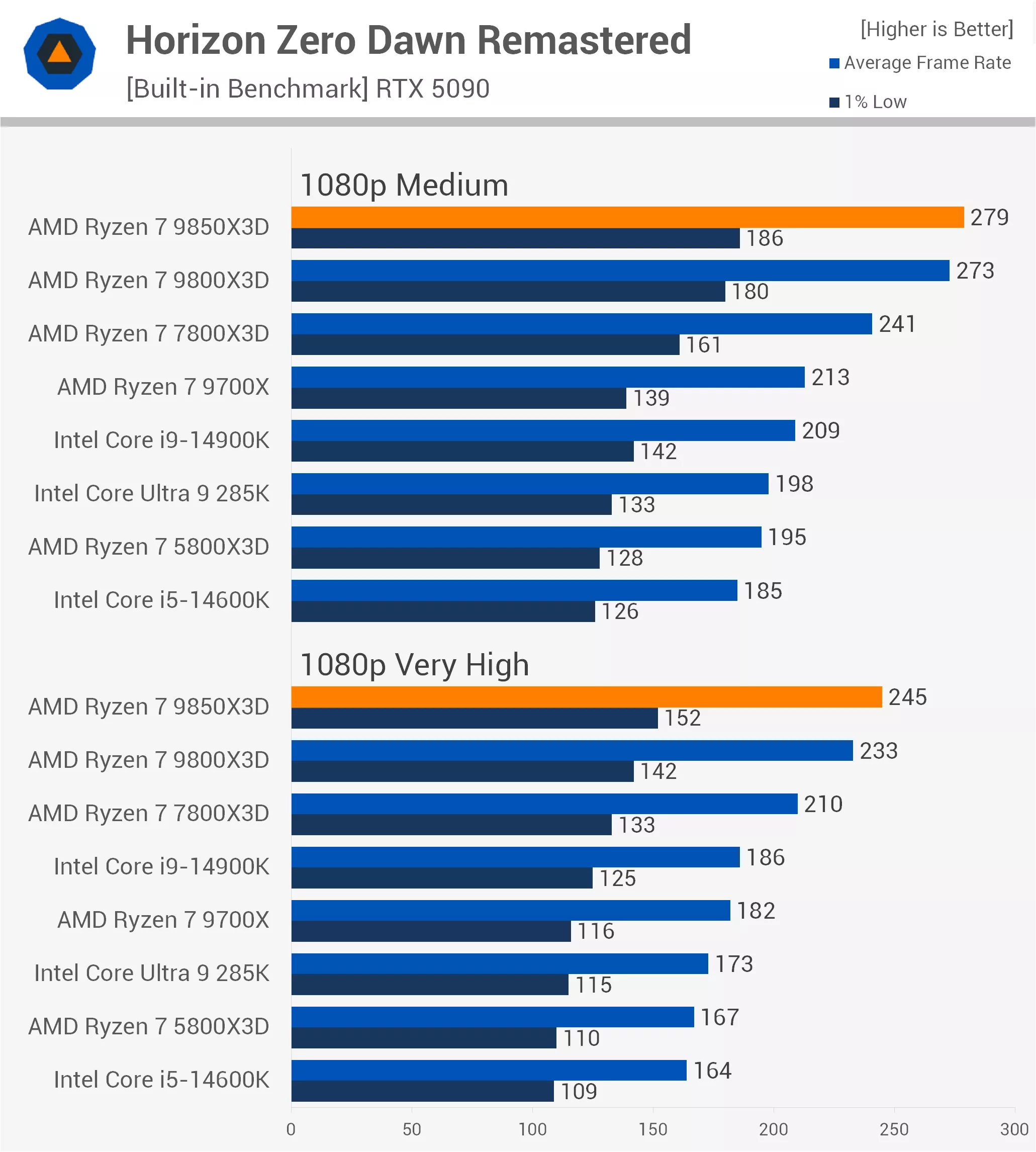
The Horizon Zero Dawn Remastered results are also interesting. Using the Medium preset, the 9850X3D is just 2% faster than the 9800X3D, but with the Very High preset the gap widens to 5%. While not a huge difference, it clearly shows that the Very High preset is more CPU-demanding than Medium.
The Last of Us Part II Remastered
Finally, in The Last of Us Part II Remastered, we see a consistent 6% increase with the 9850X3D using both presets. The 14900K results are again noteworthy – while its 1% lows are much lower than those of the 9850X3D and 9800X3D, the average frame rate is slightly higher. This behavior is consistent across both presets.

14 Game Average
Here's the 14-game average, calculated using the geomean. As expected, the 9850X3D is 5% faster than the 9800X3D overall. However, with some Ultra-quality testing pushing the RTX 5090 to its limits, the advantage shrinks to around 3% in those scenarios.

Focusing on the Medium-quality data, where performance is mostly CPU-limited, the 9850X3D is 15% faster than the 7800X3D, 28% faster than the 14900K, 34% faster than the 9700X, 40% faster than the 285K, and 43% faster than the 5800X3D.
9850X3D vs. 9800X3D
Here's a direct comparison between the 9850X3D and 9800X3D across the 14 games tested. When calculating percentage differences on a per-game basis, we arrive at a slightly different result. Using this method, the newer model is just 4% faster on average based on the Medium-quality data. In other words, the difference is minor, and overall we're looking at a very small performance increase.

9850X3D vs. 7800X3D
Compared to the 7800X3D, we see a more noticeable 14% improvement on average. Gains reach as high as 24% in Baldur's Gate 3, although some titles such as Mafia: The Old Country show only low single-digit improvements.

9850X3D vs. 9700X
When compared to the Ryzen 7 9700X, the 9850X3D is 34% faster on average, with most games showing strong performance gains. The main exceptions are Borderlands 4, which is GPU-limited even at Medium settings, and Mafia: The Old Country, which behaves similarly. Baldur's Gate 3 is an extreme outlier, though we also see gains exceeding 40% in three other titles.

9850X3D vs. 14900K
The 9850X3D also easily outperforms the Core i9-14900K in most of the games tested. The only unusual result appears in The Last of Us Part II Remastered, although the AMD processor still delivers much stronger 1% lows.

Borderlands 4 is once again GPU-limited on these high-end CPUs, while Spider-Man 2 and Mafia: The Old Country show more competitive results. In titles like ARC Raiders, Counter-Strike 2, Assetto Corsa Competizione, and Baldur's Gate 3, the 14900K is decisively outperformed.
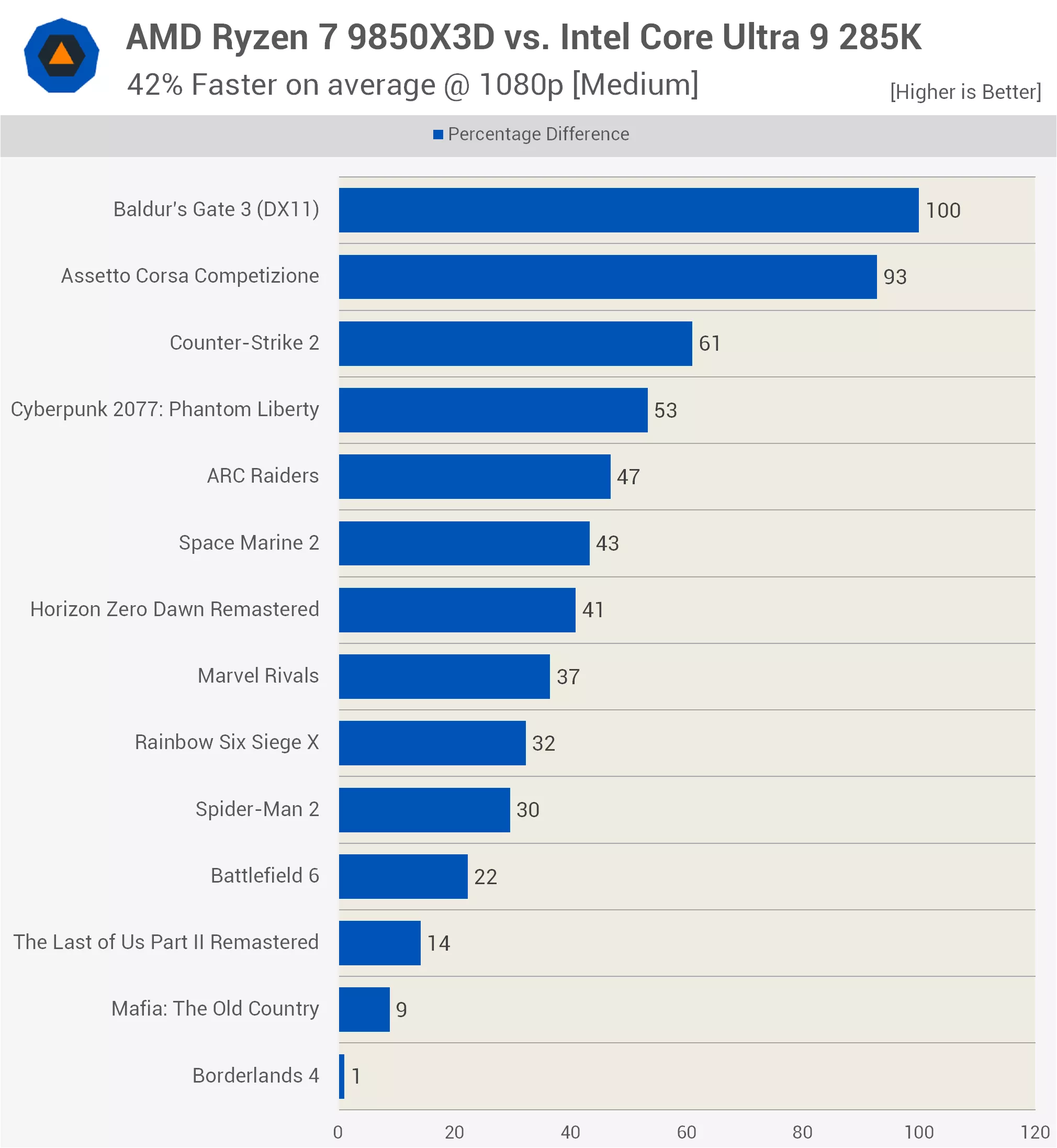
9850X3D vs. 285K
The comparison with the 285K is barely a contest when it comes to gaming. In Baldur's Gate 3, the 9850X3D is roughly twice as fast, and in Assetto Corsa Competizione it comes close to doubling performance. The gains in Counter-Strike 2 and Cyberpunk 2077 are also substantial.
Shader Performance
Another aspect of gaming performance worth examining is shader compilation time. In Marvel Rivals, as expected, the 9850X3D performs almost identically to the 9800X3D here, completing the task in 205 seconds. That's 32% slower than the 14900K and 44% slower than the 285K, both of which can leverage their large number of E-cores more effectively.

Waiting almost four minutes for shaders to compile on the 9850X3D isn't ideal, but it's also not a major issue. Shader compilation typically happens only once, or after a driver update. You're still waiting a little over two minutes on the 285K, so for an infrequent task this isn't a dealbreaker. Still, it's an area AMD will want to improve in future generations, as it remains a clear weakness.

We see similar results in Stalker 2. Here, the 9850X3D takes 238 seconds, making it 2% faster than the 9800X3D, but still 34% slower than the 14900K and 44% slower than the 285K.

Shader build time in The Last of Us Part I is particularly demanding. It's worth noting that all of these games remain playable during shader compilation, though frame rate performance can suffer as CPU utilization is maxed out. In this test, the 9850X3D is 1% faster than the 9800X3D, but still 18% slower than the 14900K and 38% slower than the 285K.
Power Consumption
Power - The Last of Us
Another important area to examine is power consumption, and this is arguably the biggest drawback of the 9850X3D – though it's far from a deal breaker. The 9800X3D is incredibly power efficient, while the 9850X3D pushes the silicon well outside its efficiency window. In The Last of Us Part I, it delivers just a 5% performance uplift for a 24% increase in power usage.

At 118 watts, it consumes almost as much power as the 9950X3D in this game, which isn't particularly efficient. Even so, power consumption remains very manageable. It's also still efficient when compared to CPUs like the 12900K, Intel's newer 285K, and it's vastly more efficient than the 14900K.
Power - Cyberpunk 2077
Power usage relative to the 9800X3D is even worse in Cyberpunk 2077. Once again, we see a 5% increase in frame rate performance from the 9850X3D, but this comes at the cost of a 35% increase in power usage. It's a bit of an Intel KS-style moment, though at least we're talking about 126 watts here – not well over 200 watts.

Power – Cinebench 2024
It's interesting that AMD didn't adjust the TDP for the 9850X3D, instead retaining the same 120 W rating as the 9800X3D. While TDP is only a thermal guideline, the 9850X3D still reached 163 watts under load, representing a 27% increase over the previous model. This makes it a notably power-hungry 8-core processor.

The Value Equation
Now that we've analyzed the benchmark results, the 9850X3D is clearly fast – but is it good value?
If you want or require the very best gaming performance, then at $500 it isn't unreasonable. However, for those chasing the best value in a high-end CPU, this isn't it. That title still belongs to the 7800X3D, which currently costs around $100 less than the 9850X3D, meaning the newer part carries roughly a 9% premium per frame.

The 9850X3D is only slightly more expensive than the 9800X3D, with a modest 2% price premium. Based on that alone, it makes sense to choose the 9850X3D if you were already considering the 9800X3D. For more budget-conscious buyers, however, the 7800X3D remains the better value and has been available for as little as $360 in recent months, so it's worth keeping an eye out for discounts before stock dries up.
DDR5 Performance
One claim AMD made in its press deck is that second-generation AMD 3D V-Cache delivers the same, or very similar, performance across a wide range of memory configurations. Their example compared DDR5-4800 (the base JEDEC specification) to DDR5-6000. AMD claims that across more than 30 games, the average performance difference between these configurations is just 1%.

While that may be true, it's somewhat of a moot point given that DDR5 memory of any kind remains significantly overpriced. When pricing is more normal (as it was for much of 2025) the cost difference between DDR5-4800 and DDR5-6000 is generally very small.
Still, we decided to test this ourselves.
AMD didn't specify the memory timings used in its testing, so we've gone with our own methodology. The DDR5-6000 configuration uses G.Skill CL30 memory with EXPO enabled. The DDR5-4800 configuration uses the same memory kit with no profile loaded, defaulting to DDR5-4800 CL40.
For reference, we also tested the 14900K and 285K using DDR5-4800 CL40 and compared those results to the DDR5-7200 and DDR5-8200 configurations originally used for those CPUs. We tested six games, so let's look at the data.
Rainbow Six Siege X
Starting with Rainbow Six Siege, AMD's claims appear to hold up. We see less than a 1% performance drop for the 9850X3D when paired with DDR5-4800 memory. In contrast, the 14900K experiences an 8-13% decrease, while the 285K sees a larger 12 – 14% drop.

While not dramatic, this means that with Medium settings and slower memory, the 9850X3D is now 33% faster than the 14900K, compared to a 16% lead with more optimal memory.
Marvel Rivals
Next up is Marvel Rivals, where we see a similar trend. Performance on the 9850X3D remains effectively unchanged with the slower memory, showing well under a 1% loss. The 14900K, meanwhile, becomes 11% slower using Medium settings and 6% slower with Ultra, while the 285K sees a 10-11% decline. As a result, with slower memory the 9850X3D is now 35% faster than the 14900K, compared to a 20% lead with faster memory.

Horizon Zero Dawn Remastered
In Horizon Zero Dawn Remastered, the 9850X3D does take a small 3-4% performance hit when using DDR5-4800 memory. The Intel CPUs suffer more significantly, with performance drops of 9-11% depending on the quality settings.

Counter-Strike 2
Counter-Strike 2 isn't particularly memory-sensitive, so it's no surprise that performance on the 9850X3D remains unchanged when moving from DDR5-6000 to DDR5-4800. Even the Intel CPUs show relatively minor losses – the 14900K is 5 – 6% slower, while the 285K is just 2 – 3% slower.

Cyberpunk 2077: Phantom Liberty
In Cyberpunk 2077: Phantom Liberty, the 9850X3D sees little to no performance loss with slower memory. There's a 4% drop using the Medium preset, but no measurable loss when using the Ray Tracing Ultra preset. The 14900K, by comparison, suffers a 13% drop with Medium settings and 9% with ray tracing enabled, while the 285K is 12-14% slower with DDR5-4800.

Space Marine 2
Finally, we looked at memory performance in Space Marine 2. Once again, the 9850X3D shows little to no performance difference when using slower DDR5-4800 memory. Meanwhile, the 14900K is 7-9% slower, and the 285K sees a 14% reduction.

For the FPS Chasers
So there you have it... the Ryzen 7 9850X3D isn't nearly as silly as we initially thought it might be. It makes more sense, at least for most consumers, than Intel's KS parts have in the past. That said, it hasn't exactly made for the most exciting product release. You're getting a small performance increase, a very modest price bump, and a significant jump in power usage, even if overall power consumption remains reasonable.

There are no real surprises here. AMD has taken the world's fastest gaming processor and made it slightly faster. For those who demand the absolute best gaming performance, the 9850X3D will be appealing. For everyone else, it's largely unnecessary.
If you're after hassle-free, high-end gaming performance, we'd still recommend the 7800X3D – especially when it goes on sale. As mentioned earlier, it has been available for as little as $360 in recent months.
Of course, if you also need to purchase memory along with your new CPU, value kind of goes right of the window. The cheapest 32 GB DDR5 kits currently sell for around $330-$350. The silver lining is that, based on the results in this review, X3D CPUs maintain their performance advantage relative to competing parts even when paired with slower DDR5 memory. Calling it "budget" memory might be generous... "less optimal" is probably a more accurate description right now.