
We're back to settle what has become an age-old debate: does Windows 11 or Windows 10 deliver better gaming performance? Microsoft has been rolling out Windows 11 25H2 for the past few months, an update that doesn't claim any performance improvements. Instead, it comes packing new Copilot AI features, Start Menu and File Explorer tweaks, security enhancements, Wi-Fi 7 support, and stripped out legacy components like PowerShell 2.0.
Performance gains may not be on the changelog, but the comparison is still worth revisiting – especially with so many gamers still using Windows 10, which is widely regarded as the better choice for gaming. Plus, since our last Windows head-to-head there's been a wave of new game releases, with many of these titles taking advantage of new features, so this should make for an interesting update.

The test configuration for this one is fairly straightforward. Each operating system has been installed on a separate, brand-new SSD. We bought a pair of Team Group T-Force G50 2TB drives, which has allowed us to swap drives easily, not only to test each operating system, but also to quickly double-check and verify results.
We stripped both operating systems down to minimize interference: we disabled virus scanning and virtualization-based security (VBS), including features like memory integrity and core isolation. To ensure these were truly disabled, virtualization was also turned off at the BIOS level.

For the hardware, we decided to go with the fastest CPU and GPU available. We've also included some bonus testing with the Radeon RX 9070 XT and Ryzen 7 9700X, but for the bulk of the benchmarks, we'll be using the Ryzen 9800X3D and Nvidia RTX 5090.
You might argue that testing with entry-level hardware could offer another perspective, as one operating system may introduce extra overhead that impacts lower-powered systems. That's something we may explore in a future article, but for now, there's already a tremendous amount of data to get through, so let's dive in.
Test System Specs
| CPU Motherboard Memory |
AMD Ryzen 7 9800X3D | Gigabyte X670E Master [BIOS F39] G.Skill Trident Z5 RGB 32GB DDR5-6000 CL30 |
| Graphics Card | Asus ROG Astral RTX 5090 OC Edition | |
| ATX Case | MSI Prospect 700R | |
| Power Supply | Kolink Regulator Gold ATX 3.0 1200W | |
| Storage | Team Group T-Force G50 M.2 PCIe Gen4 NVMe SSD 2TB | |
| Operating System | Windows 11 25H2 Windows 10 22H2 |
|
| Display Driver | GeForce Game Ready Driver 591.74 | |
Benchmarks
Rainbow Six Siege X

First up, we have Rainbow Six Siege X. The performance difference between Windows 10 and Windows 11 is very small – we're talking about a 3% margin at both 1080p and 1440p in favor of Windows 11. These results were repeatable and based on a three-run average, so it's safe to say that, at least for this configuration, Windows 11 is just slightly faster. Once we become GPU-limited, however, performance is identical, which is exactly what we see at 4K.
Battlefield 6

Moving on to Battlefield 6, we used the High preset in our Portal benchmark. Here, performance between the two operating systems was effectively identical. The three-run average had Windows 10 just 1% faster, which is well within the margin of error.
Arc Raiders
The Arc Raiders data is particularly interesting. To be clear, we went back and re-ran the test on both operating systems, and the results came back the same. Windows 11 tested 11% faster at 1080p, 14% faster at 1440p, and 15% faster at 4K.
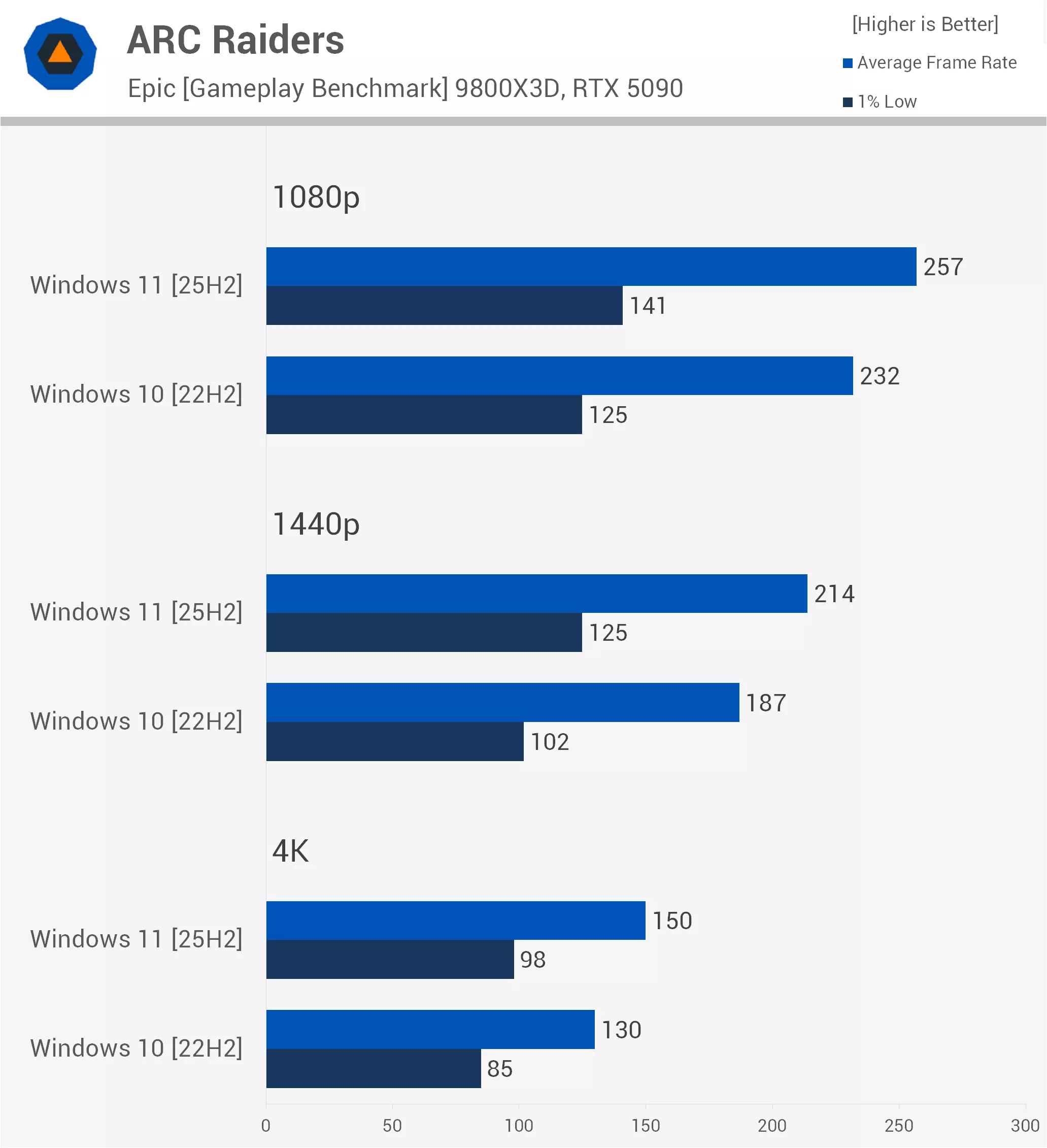
Not only is it surprising to see Windows 11 perform noticeably better here, but the margin actually increases with resolution... where normally we would expect the opposite to happen.
We also confirmed that both systems were running the exact same in-game quality settings. With no errors detected in testing, we're confident in the results, though we can't fully explain why Windows 11 is 11-15% faster in this title when games like Rainbow Six Siege X and Battlefield 6 showed virtually no difference.
Borderlands 4

It wasn't just Arc Raiders either. We saw a similar pattern in Borderlands 4, where Windows 11 provided 13% greater performance at both 1080p and 1440p. Even at 4K, where we'd normally expect results to level out, Windows 11 still remained 9% faster. That gives Windows 11 a clear performance advantage in this example.
Marvel Rivals

Marvel Rivals also ran better under Windows 11, though the gains were modest. The newer operating system was 4% faster at 1080p and 1440p, while we saw no difference at 4K.
This suggests the performance gap is likely tied to the Ryzen 9800X3D working slightly more efficiently with Windows 11.
Baldur's Gate 3

Next up is Baldur's Gate 3, another title that performs slightly better on Windows 11 in our setup. At both 1080p and 1440p, we measured a 6% improvement, though that margin was cut in half at 4K, where performance ended up being much the same.
Cyberpunk 2077: Phantom Liberty

Cyberpunk 2077: Phantom Liberty performed almost identically on both operating systems. Windows 11 was slightly faster at all three tested resolutions, but the largest gap was only around 2%, which is within the margin of error and not something anyone would realistically notice.
Counter-Strike 2

Counter-Strike 2 is another example where we saw no meaningful performance difference. We're looking at less than a 1% deviation, which aligns closely with what we observed in other online shooters like Rainbow Six Siege X and Battlefield 6.
Space Marine 2

Windows 11 was slightly faster in Space Marine 2, delivering 2 – 3% better performance at all three tested resolutions. This margin was replicated after a second pass using the same three-run average, so Windows 11 does appear to offer a small advantage here.
Mafia: The Old Country

Mafia: The Old Country is a relatively new and very demanding AAA title, and it also ran best on Windows 11. We saw 6% greater performance at 1080p, along with 14% stronger 1% lows.
At 1440p and 4K, the advantage dropped to just 2 – 3%. The margins aren't massive overall, but when more CPU-limited, Windows 11 did perform better.
Assetto Corsa Competizione

The Assetto Corsa Competizione results showed no real performance difference between the Windows versions, similar to what we saw in Counter-Strike 2.
It does seem that lighter or older titles tend to show little to no separation between Windows 10 and 11 – though that isn't always the case, as Battlefield 6 demonstrated.
Spider-Man 2

Moving on to Spider-Man 2, we find yet another example where Windows 11 was faster. It delivered 7% greater performance at both 1080p and 1440p, and even 5% better performance at 4K. As noted with Arc Raiders, these results were unexpected, so we re-ran the tests – this time using the Radeon RX 9070 XT.
Spider-Man 2 (Radeon 9070 XT)

This completely changed the outcome. With the RX 9070 XT, all three tested resolutions showed Windows 10 and Windows 11 delivering identical results, with no measurable deviation.
This throws a bit of a spanner in the works and clearly demonstrates that performance variations between operating systems can be hardware-dependent, so it's important to keep that in mind.
Horizon Zero Dawn Remastered

Moving on to Horizon Zero Dawn Remastered, we used the built-in benchmark for this testing, as it makes the results easier to verify. Here, we found Windows 11 to be 10% faster at 1080p and 1440p, and surprisingly 8% faster at 4K.
So there's a clear performance advantage for Windows 11 in this title, which led us to verify the result using a slower CPU.
Horizon Zero Dawn Remastered (Ryzen 7 9700X)

We installed the Ryzen 7 9700X and re-ran the tests, only to find very similar margins. At 1080p and 1440p, Windows 11 was 9% faster, and then 7% faster at 4K. Overall, the performance gap was nearly identical to what we saw with the Ryzen 9800X3D.
The Last of Us Part II Remastered

The Last of Us Part II Remastered delivered the most confusing results of all the games we tested. This data was confirmed multiple times – we honestly lost count of how many times we went back and forth between Windows 10 and 11 trying to figure out what was happening.
At 1080p, Windows 10 was reliably 6% faster than Windows 11 in average frame rate, and 12% faster in the 1% lows.
Things became confusing at 1440p, where the results flipped and Windows 11 was now 6% faster. Even more puzzling was the 4K data, where Windows 11 surged ahead by 24%, averaging 155 fps compared to Windows 10, which topped out at 125 fps.
These results don't really make sense, but after validating them repeatedly, we're confident they're accurate... we just can't fully explain why.
The Last of Us Part II Remastered (Ryzen 7 9700X)

To better understand what was going on, we swapped the Ryzen 9800X3D for the 9700X, though this didn't really clarify things.
Once again, Windows 10 was faster at 1080p, this time by 5%. At 1440p, performance was effectively identical, before Windows 11 pulled well ahead at 4K. It's puzzling stuff.
The Last of Us Part II Remastered (Radeon 9070 XT)
At this point, we suspect the issue may be related to a bug with the RTX 5090, possibly a driver problem. When we switched over to the Radeon RX 9070 XT, the results made far more sense.

With the Radeon GPU, Windows 11 was just 3% faster at 1080p and 1440p, shrinking to only 2% at 4K. This aligns much more closely with what we observed in other modern AAA titles.
Ratchet & Clank: Rift Apart
Finally, we looked at Ratchet & Clank: Rift Apart because it's easy to disable DirectStorage in this title, and we wanted to see whether it affected one operating system more than the other.
With DirectStorage enabled, results were very similar at 1080p and 1440p, with only slightly better 1% lows for Windows 11. Interestingly, Windows 11 did end up 6% faster at 4K.

With DirectStorage disabled, we saw nearly the same outcome – no real difference between the operating systems at 1080p and 1440p, while Windows 11 still pulled slightly ahead at 4K.

14 Game Average
Here's our 14-game average for this test, calculated using the geomean. At 1080p, Windows 11 was on average just 4% faster across the games tested, and then 5% faster at both 1440p and 4K.
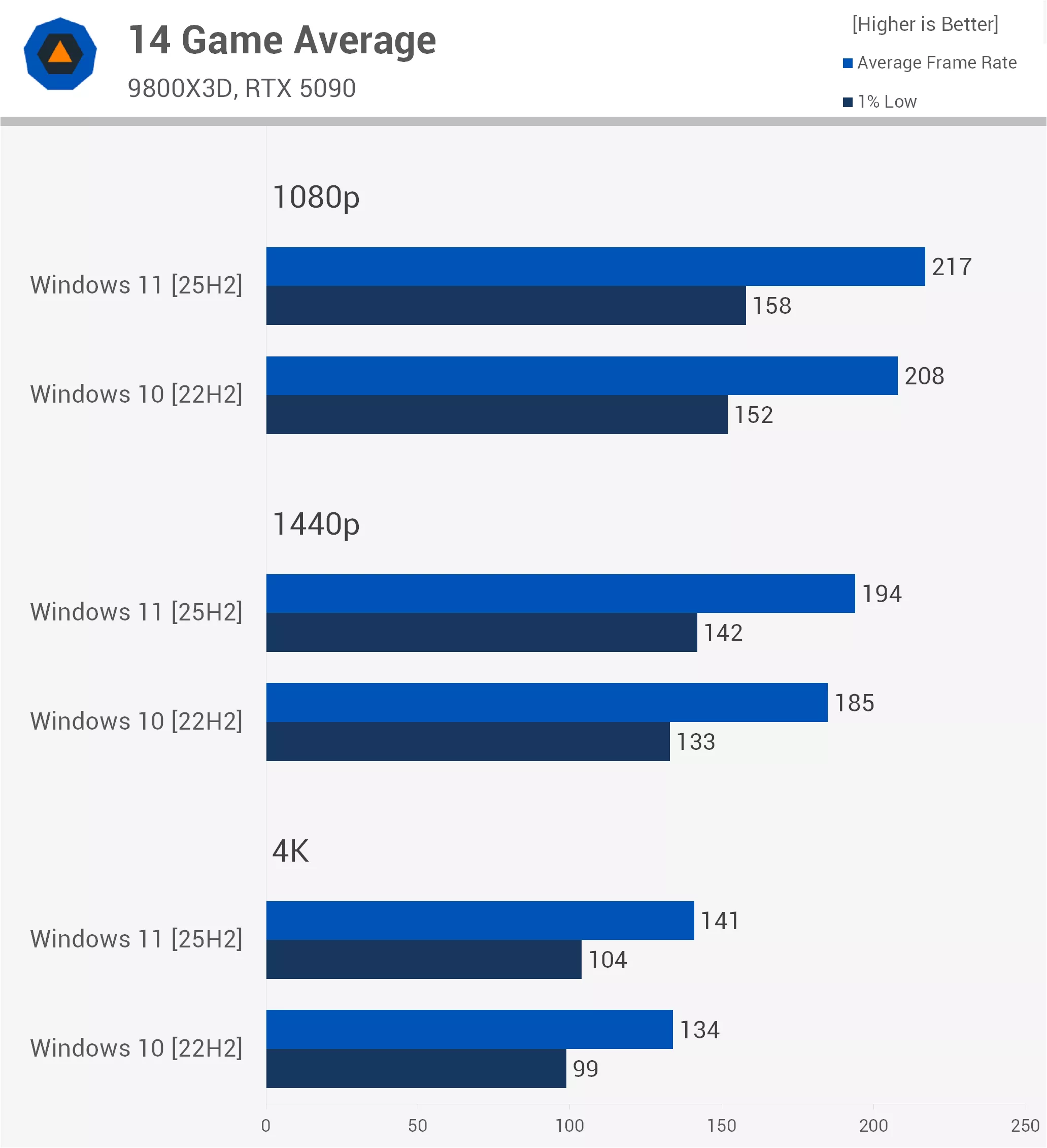
Much of the difference could potentially come down to the GeForce driver, as we saw in Spider-Man 2, but without substantial testing using the Radeon 9070 XT, we can't say for sure. Either way, across a reasonably large selection of games, the performance difference between the two operating systems is very small.
The Bottom Line: Windows 11 Takes a Narrow Lead
The verdict? Windows 11 25H2 edges ahead of Windows 10 in gaming performance, though your mileage will vary depending on the hardware configuration, and we obviously can't benchmark every configuration imaginable.

When we last ran this comparison in late 2024, when we compared Windows 11 23H2 against Windows 10 22H2, the older OS held a slight advantage. Microsoft's 24H2 update addressed several performance bottlenecks, particularly for Ryzen chips, though those branch prediction optimizations were supposedly backported to Windows 10 as well.
The reality is that gaming performance between the two Windows versions remains remarkably close, as our 14-game average demonstrates. Some newer titles do seem to favor Windows 11, and Microsoft touts improved DirectStorage support and better resource allocation for modern CPUs/GPUs, claims we haven't been able to independently verify.

Your choice ultimately comes down to personal preference and your specific setup. For the record, we have zero skin in this game, we're hardly Windows 11 evangelists, and we've dedicated hour-long discussions dissecting just how disappointing the Windows experience has become.

On that note, however, Microsoft is now positioning Windows 11 as its flagship gaming platform, with promised 2026 updates targeting background process management, power scheduling, graphics stack improvements, and driver optimizations – a response to Steam Deck and Linux gaming's momentum. The roadmap includes Xbox Fullscreen Experience, Shader Delivery, DirectX Raytracing 1.2, AI-accelerated rendering, and enhanced Arm support, all designed to deliver console-like, high-performance experience on PCs by optimizing system behavior and reducing bloat.
Whether any of that materializes remains to be seen. We're cautiously optimistic at best.