
GPU pricing is all sorts of messed up, something we recently covered in depth in a separate article. But one aspect we didn't spend much time on was how this affects the current competitive landscape between Nvidia, AMD, and Intel.
We know GPU pricing has gone up considerably across the board, and generally speaking, GeForce GPUs have risen more than Radeon and Arc graphics cards. But where does that leave the key battles across different price points and regions?
Granted, with the market in its current state, we're not sure how many of you will actually be interested in updated cost-per-frame charts based on current GPU prices to then use this data to go out and purchase a graphics card, but at the very least, it's an interesting look at where things stand after substantial price changes over the past month.
The pricing data here is identical to what we showed two weeks ago, gathered across the same 10 countries using the same methodology and showing the lowest price for in-stock models. Performance data comes from our latest testing, so the margins between cards should be similar to our latest big benchmark reviews looking at 50+ games. Those tests include a mixture of rasterized and ray-traced titles.
MSRP
First, a brief refresher on what the market should look like with every card selling at MSRP. This is roughly where things stood a year ago, before the huge upward pricing trend began.
The best-value GPUs on the market were typically Intel's Arc B580 series, which undercut competing models with aggressively low prices at or below $250. The Radeon RX 9060 XT series wasn't far behind, especially if you wanted higher performance and more VRAM for a modest increase in price.
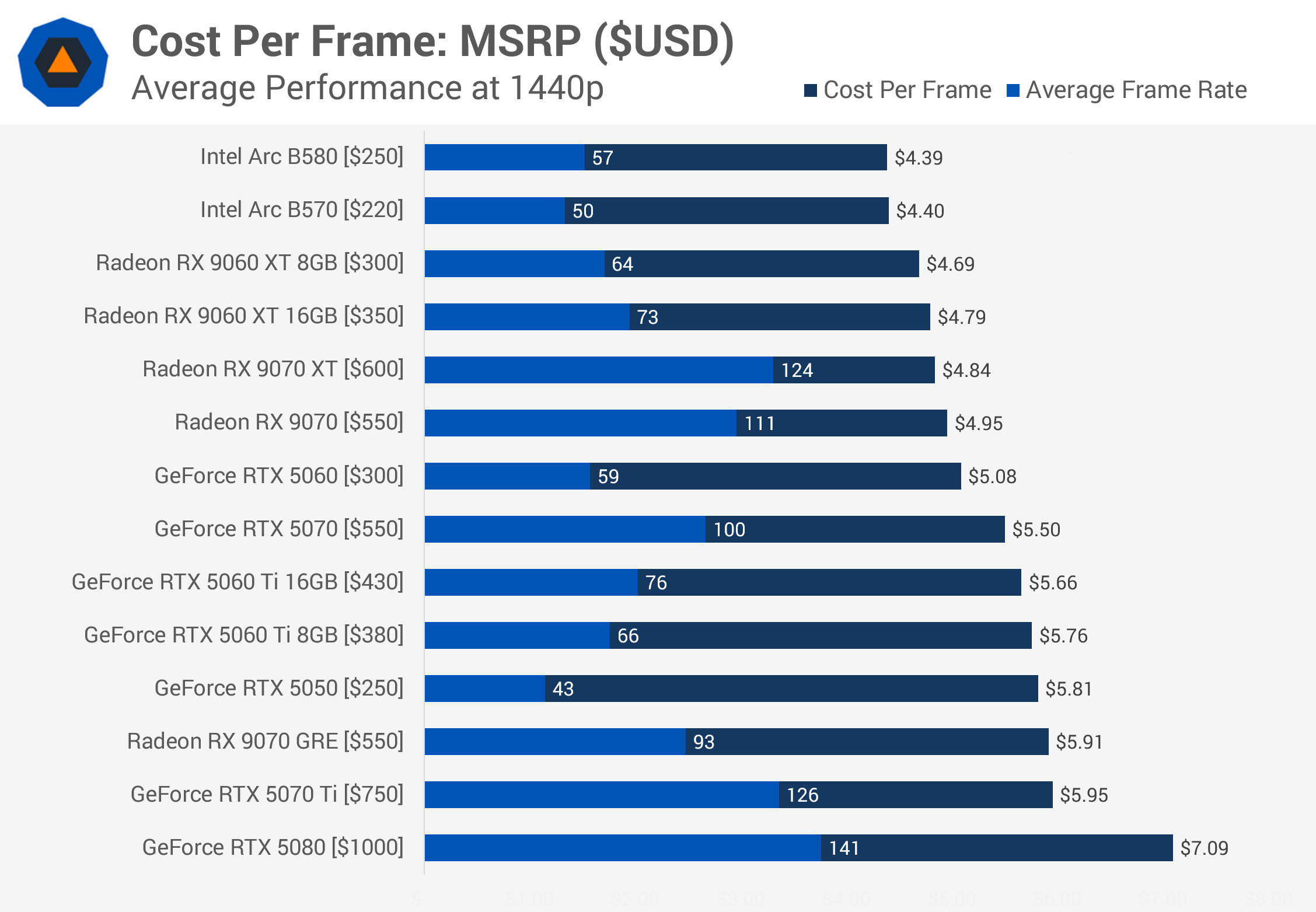
In the mid to upper end of the market, the Radeon RX 9070 XT and RX 9070 tended to make the most sense. At its proper $600 price, the 9070 XT delivered a 12% lower cost per frame than the RTX 5070, and nearly 20% lower cost per frame than the RTX 5070 Ti.
The RTX 5050 made absolutely no sense at its price given its low performance, while the RX 9070 GRE, which arrived later at the same $550 price as the RX 9070, also would have made little sense if every GPU were selling at MSRP.
United States
Here's where things actually stand in the US market right now. The first thing you might notice is that we've omitted the RTX 5090 from this chart entirely. At $5,000, we simply don't consider it a gaming GPU anymore. That's workstation pricing, and naturally, its cost per frame for gaming is atrocious.
For this analysis, we want the focus to remain on genuine gaming products. If the RTX 5090 falls back to something more sensible, it can regain its status as a gaming GPU and return to these charts. For now, it doesn't make the cut, just as the RTX Pro 6000 doesn't make the cut.
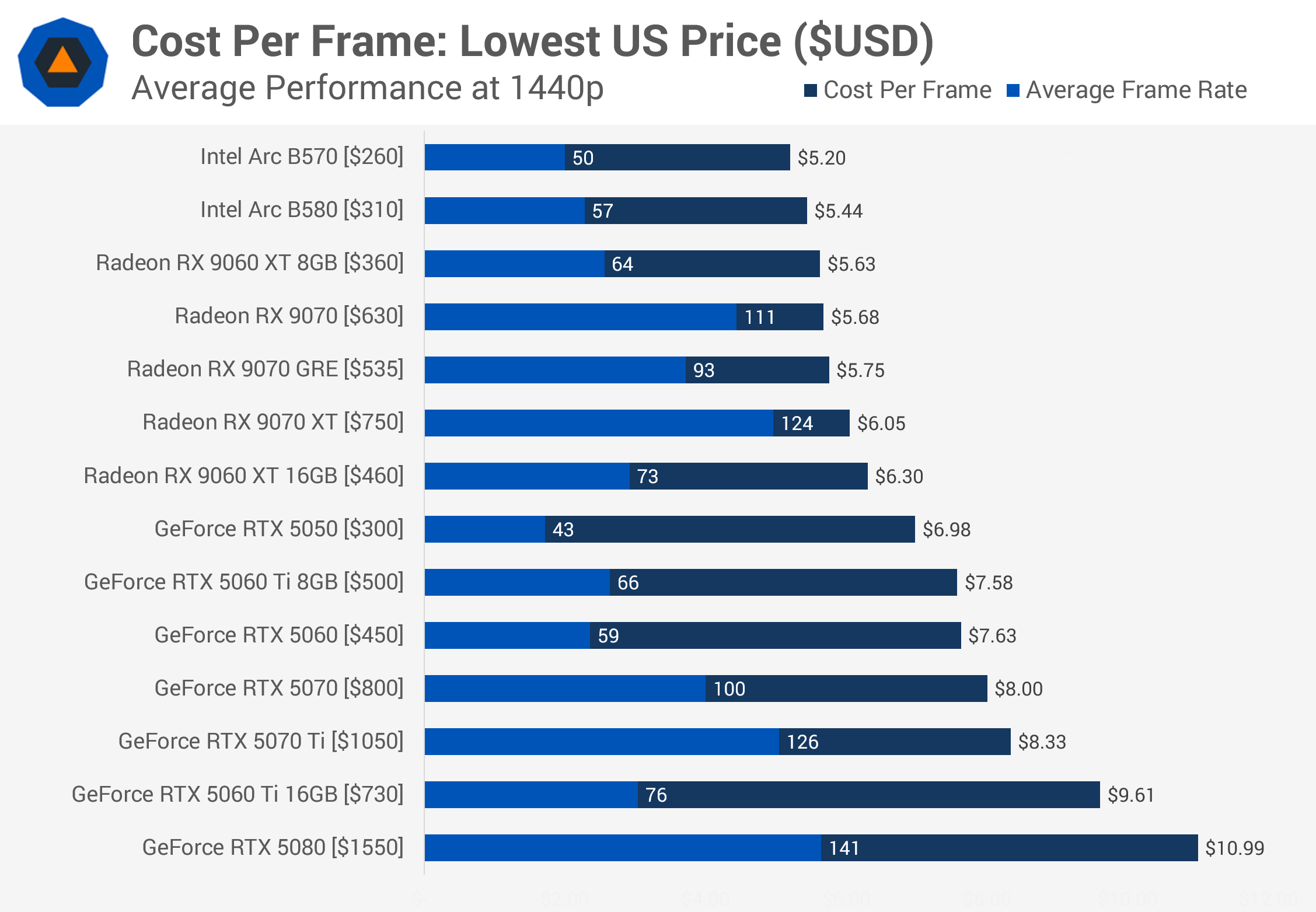
At the entry level, the best-value GPU right now is technically the Arc B570, which offers a slim 8% lower cost per frame than the RX 9060 XT 8GB. The Arc B580 is very similar to the 9060 XT 8GB by this metric, though it comes with more VRAM at 12GB versus 8GB, a precious commodity these days. The only other card sitting below $400 is the RX 5050, which offers significantly worse value because it's much slower.
The next tier up has the RX 9060 XT 16GB and the RTX 5060 at similar prices. Not only does the 9060 XT 16GB have double the VRAM, it's also considerably faster, making the Radeon GPU 17% cheaper per frame. Neither model is ideally priced given they're supposed to sit in the $300 to $350 range, but at around $450, the Radeon card seems like a much better buy.
With price increases affecting the RTX 5060 Ti 16GB and RTX 5070, Nvidia is leaving the $600 price tier pretty much unopposed these days. The RX 9070 GRE and RX 9070 offer similar value in terms of cost per frame in this range, although the 9070 is slightly ahead and comes with more VRAM, 16GB versus 12GB.
The closest GeForce GPU to $600 is the RTX 5060 Ti 8GB, a comparatively poor purchase.
The RX 9070 XT offers similarly strong value and dominates the upper price tiers in terms of cost per frame. Around this price, we also have the RTX 5060 Ti 16GB and RTX 5070, neither of which is competitive.
The 9070 XT is 24% cheaper per frame than the RTX 5070 and a massive 37% cheaper per frame than the RTX 5060 Ti 16GB. Not even a feature like DLSS can compensate for a discrepancy in raw performance that large. The RTX 5070 Ti doesn't fare much better, with the 9070 XT currently offering a 27% lower cost per frame.
Australia
In Australia, the overall shape of the market is similar to the United States, although some specific matchups shift around. In the US, for example, the RTX 5060 competes with the RX 9060 XT 16GB on price, whereas in Australia, the GeForce model lines up more closely with the 9060 XT 8GB.
The Radeon card is still 8% cheaper per frame, but this does make GeForce significantly more competitive at the lower end of the GPU market. That said, over the past few days we've noticed both models becoming more expensive than the prices recorded a week ago.
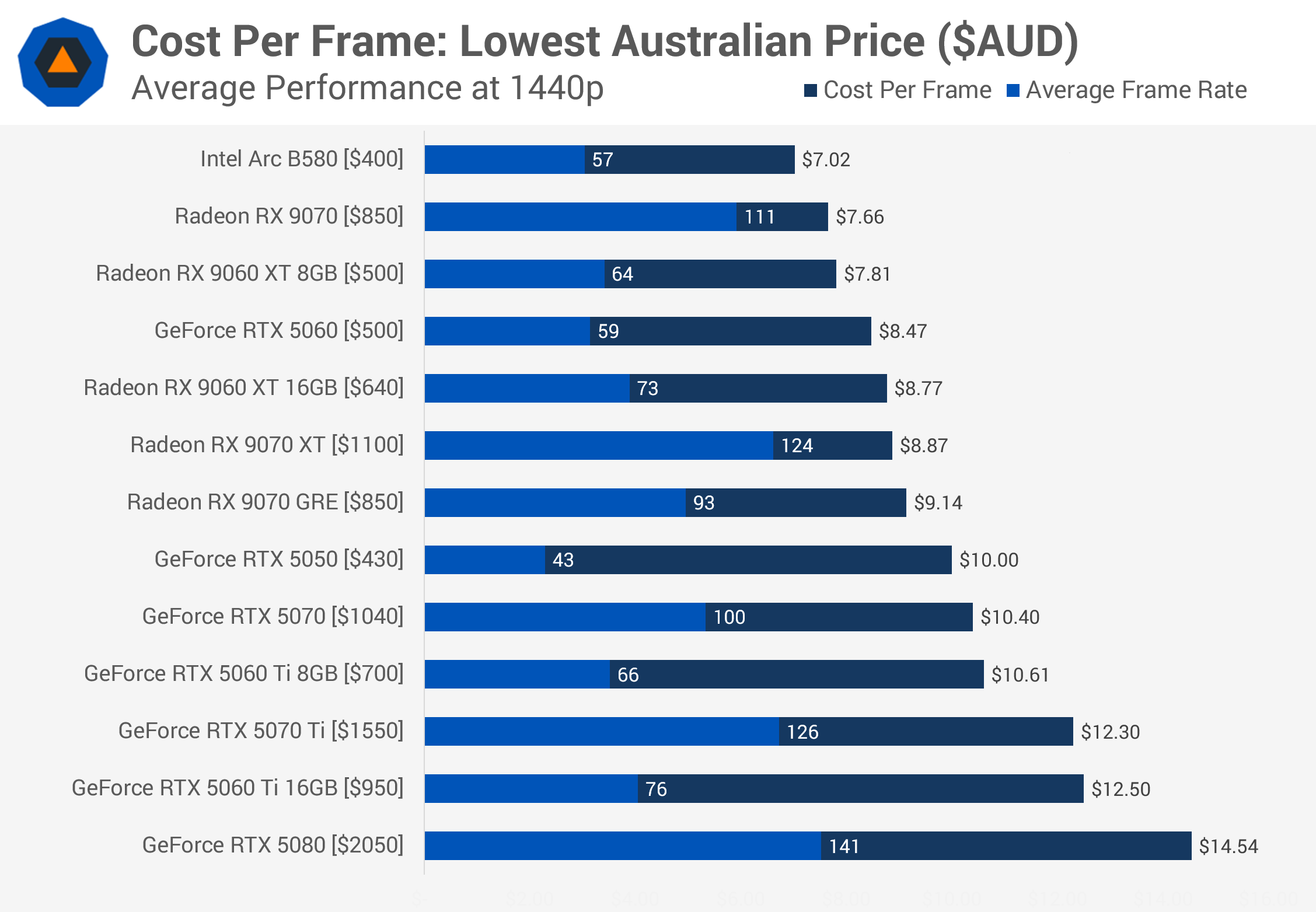
At around $700, the RX 9060 XT 16GB competes against the RTX 5060 Ti 8GB, and this is a pretty clear win for the Radeon card. Not only is it 17% cheaper per frame, it also offers double the VRAM, which makes a considerable difference in modern games.
At around $900, we have the RX 9070 and RX 9070 GRE competing against the RTX 5060 Ti 16GB. So this isn't quite the 9070 XT versus 5060 Ti 16GB battle we see in the US, but it's still a very poor position for GeForce. The 5060 Ti 16GB is the second-worst-value GPU in the Australian market, with the RX 9070 offering a 39% lower cost per frame.
At $1,100, we also have the RX 9070 XT versus RTX 5070 battle, where the Radeon GPU delivers a 15% lower cost per frame while also offering more VRAM. As in the US, the RTX 5070 Ti isn't competitive here, costing more than $400 extra.
United Kingdom
In the UK, Intel's Arc GPUs aren't as competitive on value, which pushes the RX 9070 into the top spot on the cost-per-frame chart. This model costs £550, compared with £600 for both the RTX 5070 and RTX 5060 Ti 16GB, resulting in a 17% and 37% lower cost per frame, respectively.
The RX 9070 XT is also good value for a little more money, though not quite as strong as the RX 9070.
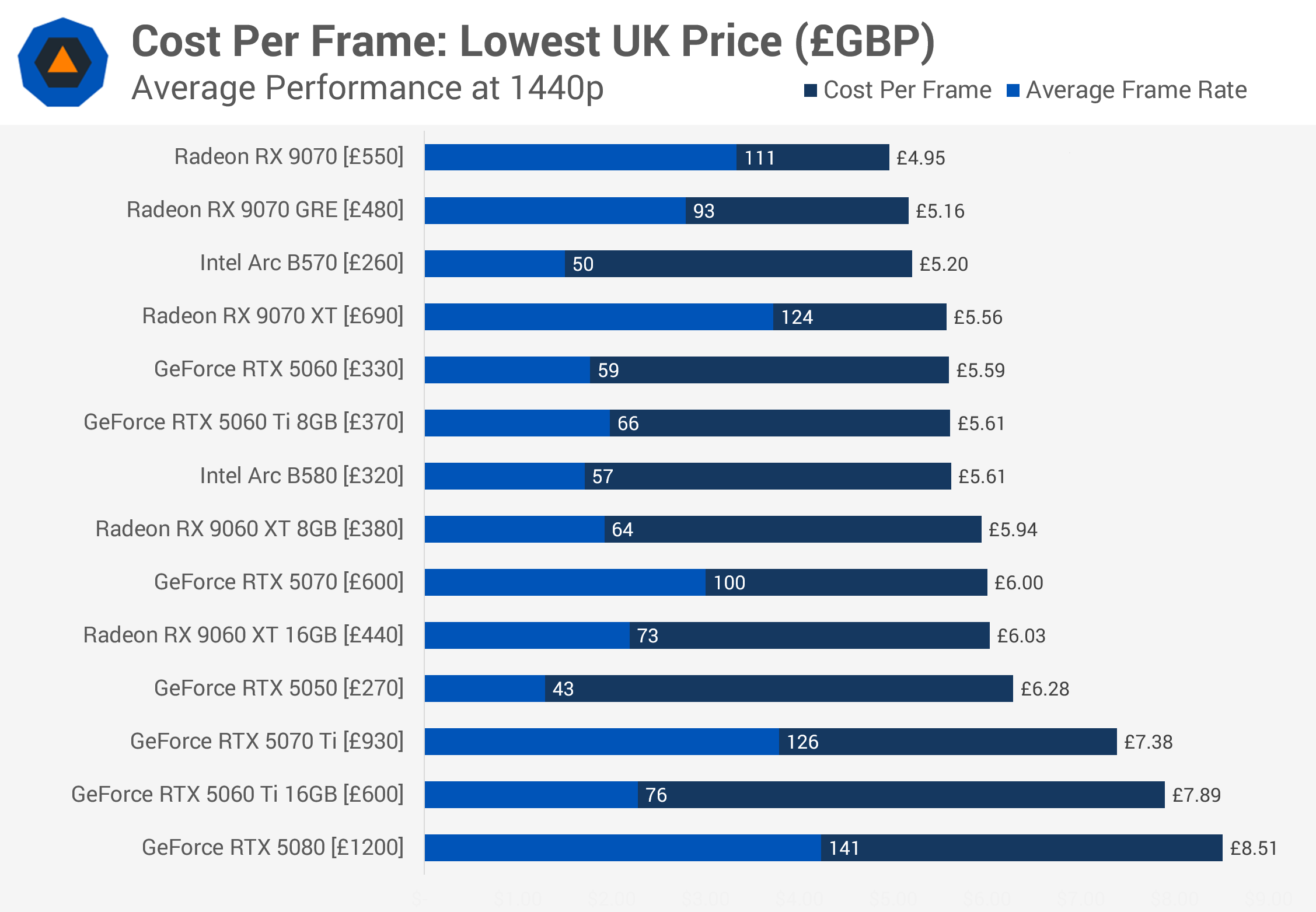
If you're after an entry-level GPU, the RX 9060 XT 8GB doesn't make much sense in the UK. It's priced at roughly the same level as the RTX 5060 Ti 8GB while offering worse value than both that card and the RTX 5060.
None of these models are particularly compelling given they all have just 8GB of VRAM, but it's also a tough ask to spend another £100 on the RX 9060 XT 16GB. That model isn't amazing value either and costs 33% more. So the UK market looks reasonably healthy if you're shopping for a higher-tier GPU, but underwhelming for budget buyers.
The premium GeForce offerings aren't in a great position right now, which, somewhat ironically, makes the RTX 5080 look relatively good. It costs roughly twice as much as an RTX 5060 Ti 16GB but also delivers nearly twice the performance, leaving it just 8% more expensive per frame.
At MSRP, the RTX 5080 carries a healthy high-end tax, costing 25% more per frame than the RTX 5060 Ti 16GB. That gap has shrunk dramatically as memory-driven price inflation has pushed up the cost of lower-tier GeForce models.
Canada
In Canada, Arc GPUs are in a reasonable position relative to other low-end options. The B580, for example, is 9% cheaper per frame than the RX 9060 XT 8GB. Around the same price you'll also find the RTX 5060, which offers decent value, and the RTX 5050, which is much worse.
We haven't seen quite as much price inflation for the RTX 5060 in Canada as we have in the US, so GeForce remains reasonably competitive at this end of the market.
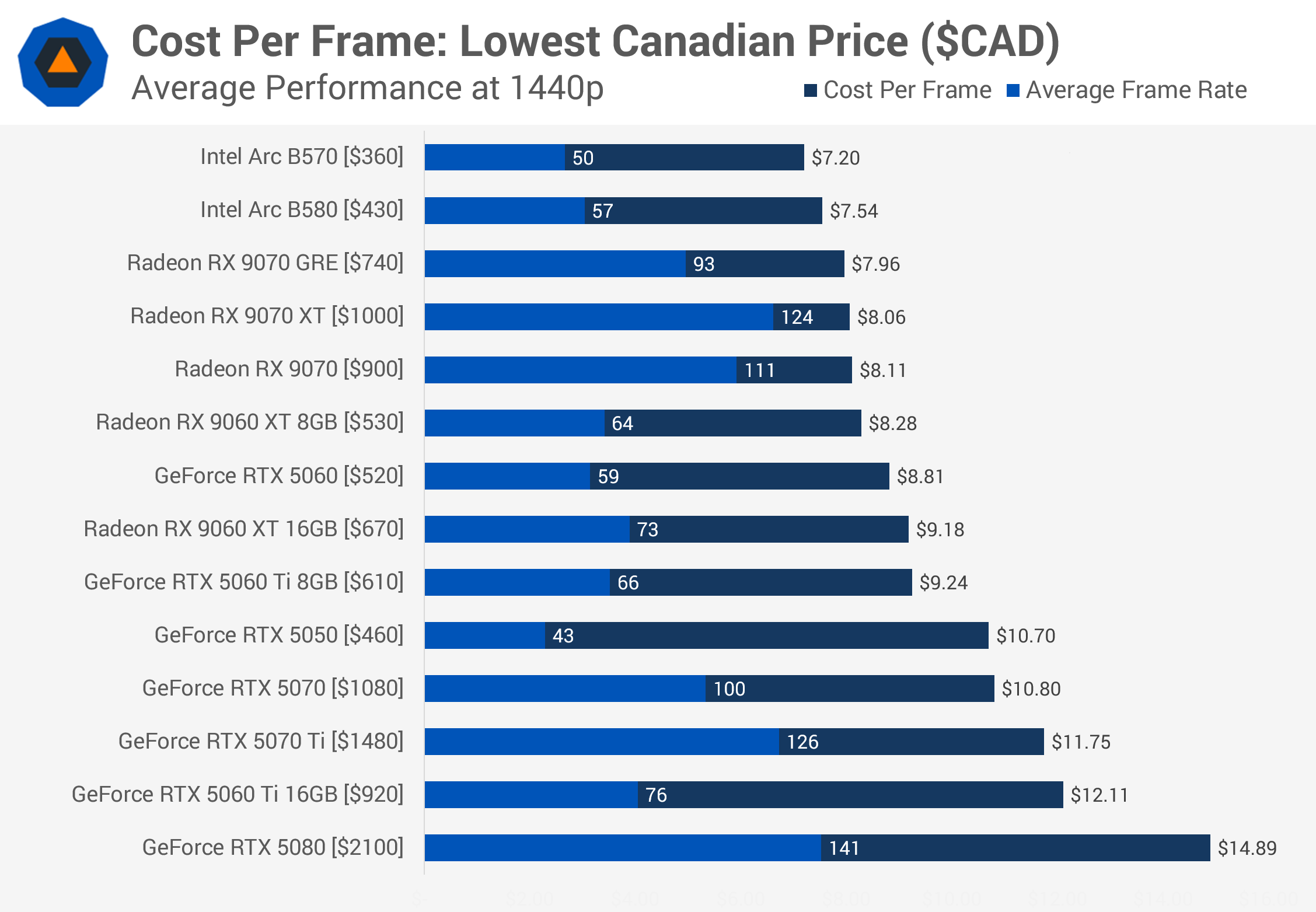
The next tier up brings us to the RX 9060 XT 16GB, which delivers similar cost-per-frame value to the RTX 5060 Ti 8GB. We'd comfortably recommend the Radeon model, however, thanks to its much larger VRAM capacity.
From there, there's a huge price gap to the next GeForce options, with the RTX 5060 Ti 16GB at $920 and the RTX 5070 at $1,080. Here, the RX 9070 XT is 25% cheaper per frame than the RTX 5070 and 33% cheaper than the RTX 5060 Ti 16GB, leaving AMD firmly ahead in this price range.
As in the UK, the RX 9070 GRE is reasonably priced, but it isn't enough of a standout relative to the other 9070 models to compensate for its lower memory capacity.
Germany
Heading back to Europe, the Arc B570 is the clear cost-per-frame leader in Germany, followed by a large group of mostly Radeon GPUs. Despite appearing much higher on the chart, the RX 9060 XT 8GB offers only an 8% lower cost per frame than the RTX 5060 and RTX 5060 Ti 8GB. That's decent value, but hardly a runaway win for AMD.
The clear entry-level standout is the RX 9060 XT 16GB. It's priced similarly to the RTX 5060 Ti 8GB, offers slightly better cost-per-frame value, and comes with double the VRAM. We'd happily spend the extra €65 over the 8GB 9060 XT to get this variant.
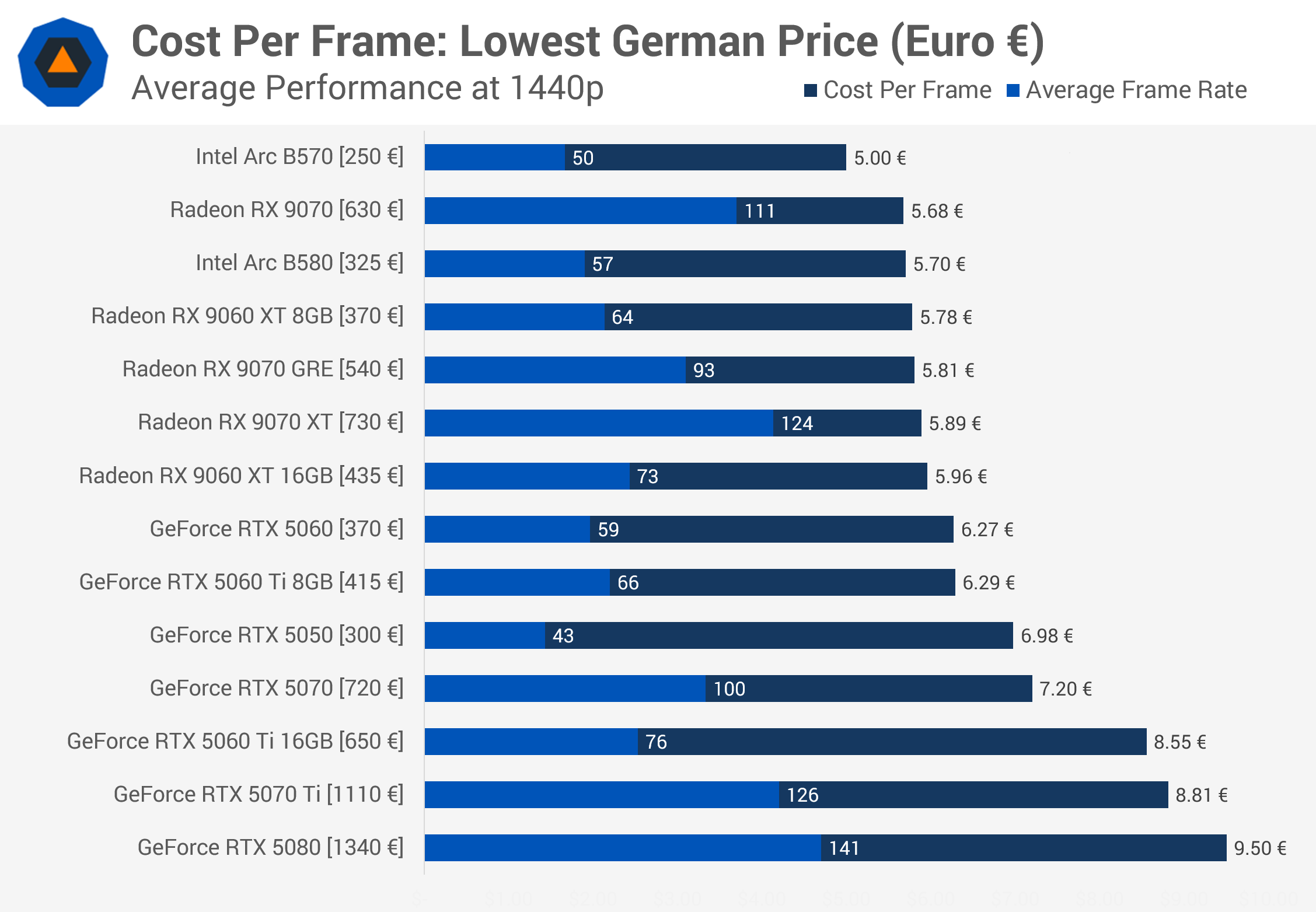
Once we reach the €600 mark, we find the RX 9070 and RX 9070 GRE from AMD alongside the RTX 5060 Ti 16GB, which is actually more expensive than both Radeon models. Comparing the RX 9070 with the 5060 Ti 16GB, the Radeon GPU is 34% cheaper per frame, making it the obvious choice.
The RX 9070 is also slightly better value than the 9070 XT, and we'd choose it over the GRE as well thanks to its additional VRAM, despite both cards landing in a similar position on the value chart.
The RX 9070 XT's nearest competitor is the RTX 5070, with both priced at around €720. This leaves the Radeon model 18% cheaper per frame, while it also delivers a 33% lower cost per frame than the RTX 5070 Ti.
Interestingly, there isn't a huge difference in value between the RTX 5070 Ti and RTX 5080 in Germany. It's getting to the point where anyone considering a 5070 Ti might be better off paying the relatively small premium and stepping up to the 5080 instead.
Netherlands
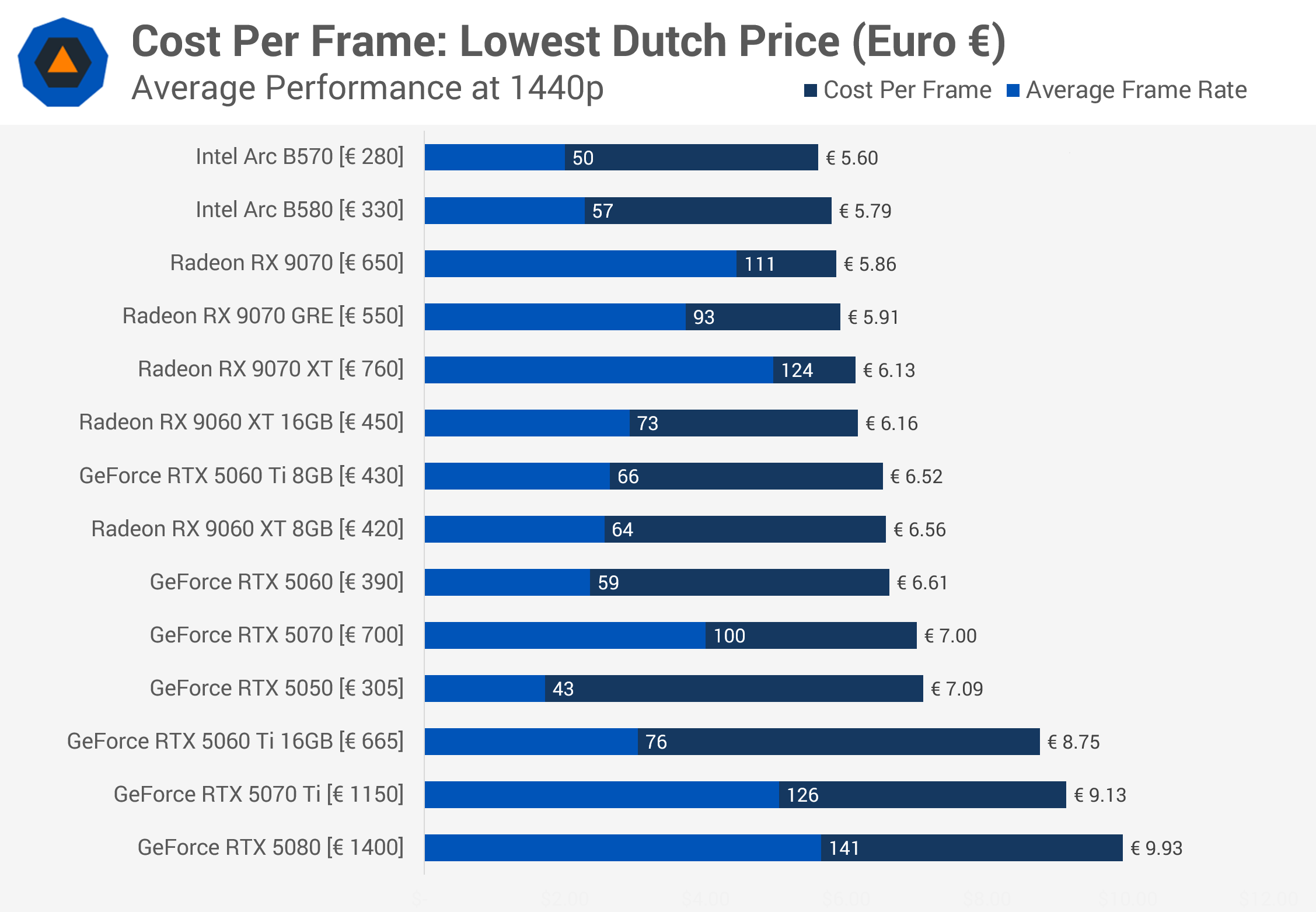
In the Netherlands, we're not seeing a huge difference compared with Germany. The RTX 5070 is slightly better value here, narrowing the gap between it and the RX 9070 XT, but the RX 9070 is still significantly better value than the RTX 5060 Ti 16GB, despite both models selling at the same price.
The main difference is probably the RX 9060 XT 16GB, which is actually better value per frame than the 8GB model in this market, largely because the 8GB version is far too expensive.
India
The Indian market is quite unusual at the moment. GPU buyers there are getting absolutely hammered on GeForce pricing. As you can see in the chart, there's a clean split, with all five Radeon models at the top and Nvidia's GPUs below them.
There are some pretty wild discrepancies here. The RX 9070 XT is 29% cheaper per frame than the RTX 5070, 41% cheaper than the RTX 5060 Ti 16GB, and 42% cheaper than the RTX 5070 Ti.
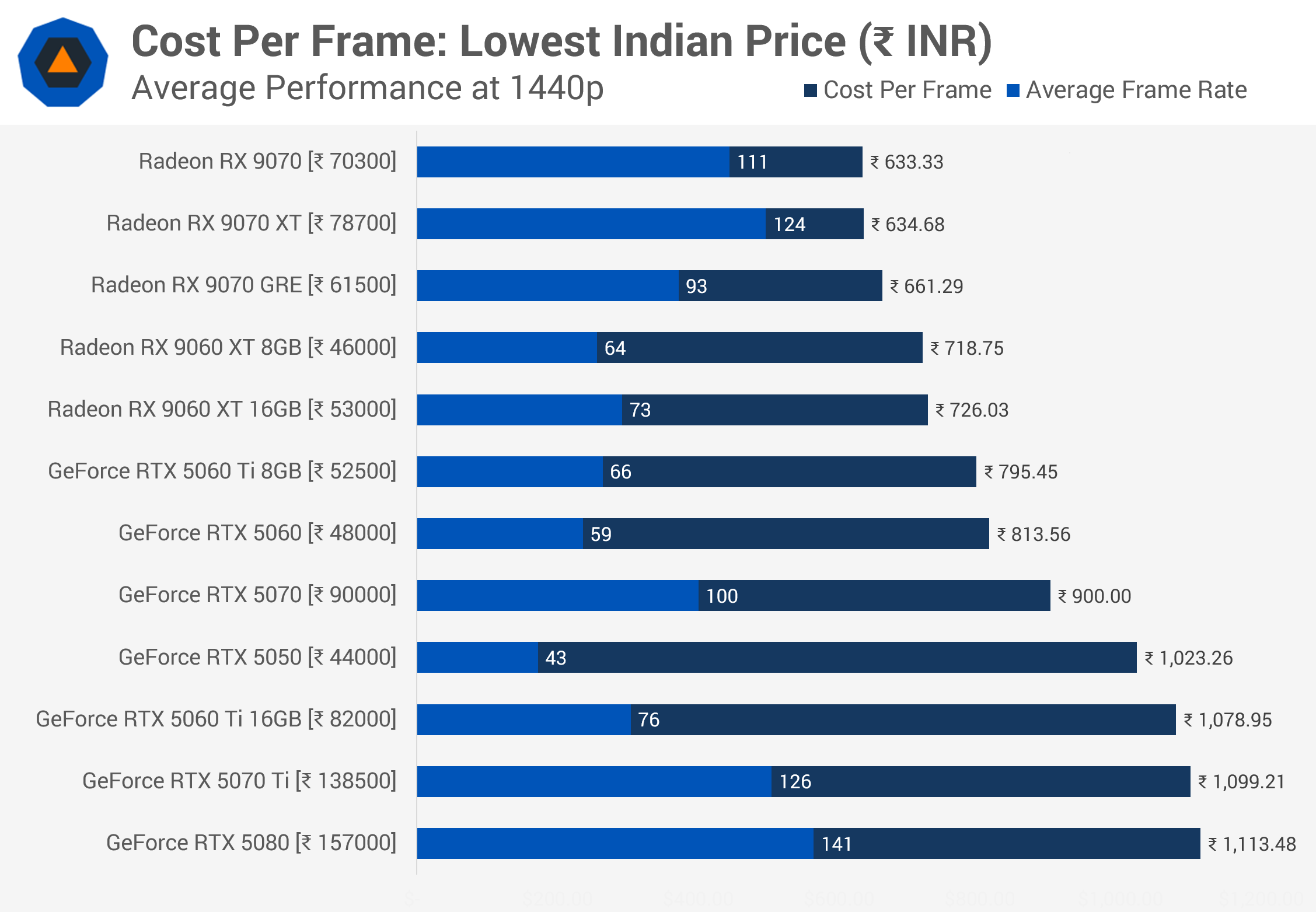
The closest battles are at the lower end of the market. The RX 9060 XT 8GB is just 10% cheaper per frame than the RTX 5060 Ti 8GB, but given the pricing of the RX 9060 XT 16GB, that's the model we'd choose. It costs the same as the RTX 5060 Ti 8GB and only 10% more than an RTX 5060, while offering 16GB of VRAM.
The RTX 5050, as in many other regions, remains a truly abysmal choice.
Philippines
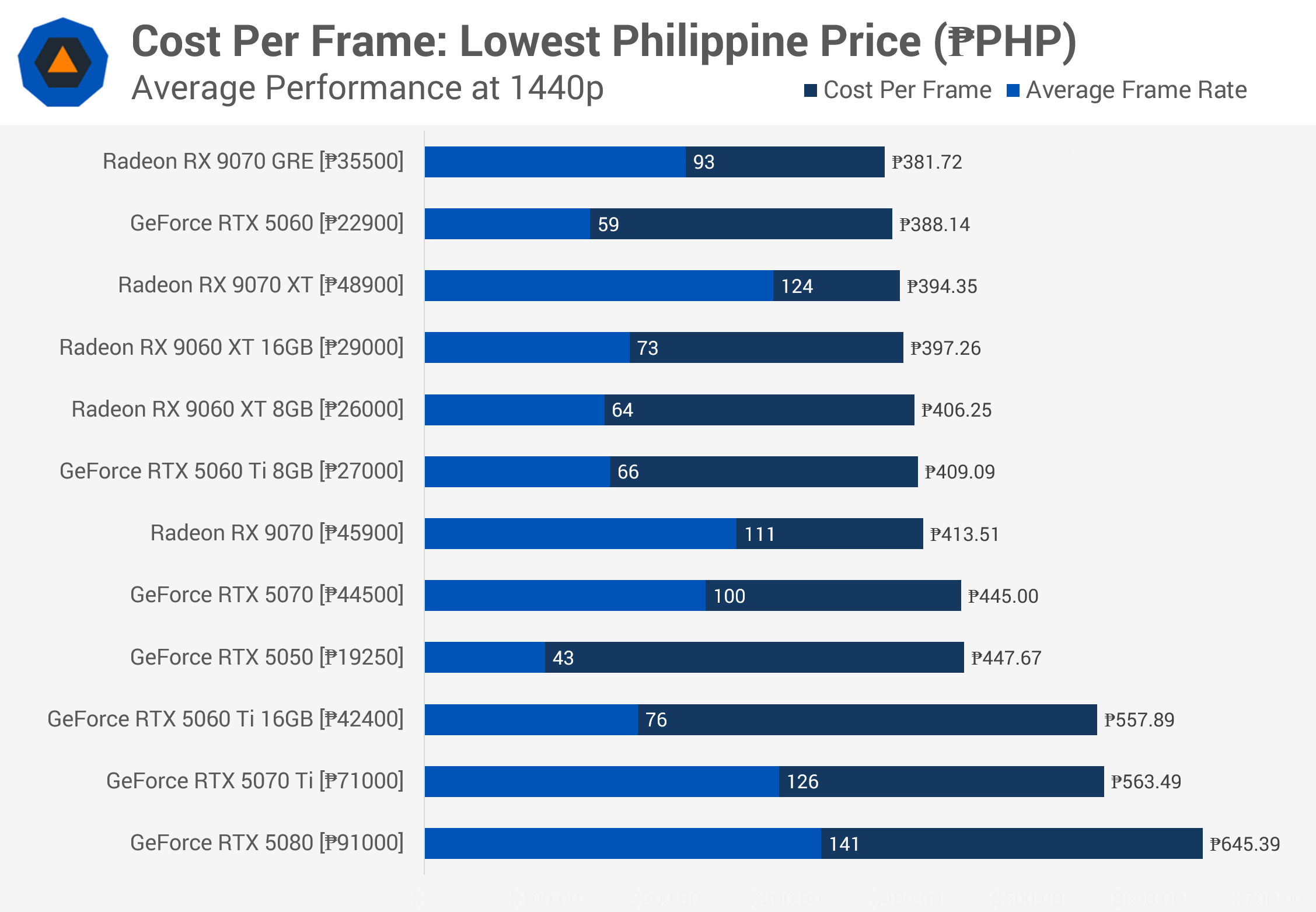
In the Philippines, it's much the same story. The RX 9070 XT is 29% cheaper per frame than the RTX 5060 Ti 16GB, although it's just 11% cheaper than the RTX 5070, one of the smaller margins we've seen between those two products.
The RTX 5060 offers reasonable value at the lower end of the market, with an overall price that's 20% lower than the RX 9060 XT 16GB. But again, if you can afford it, we think the 16GB Radeon model is the better choice given its similar cost per frame and much larger VRAM capacity.
Poland
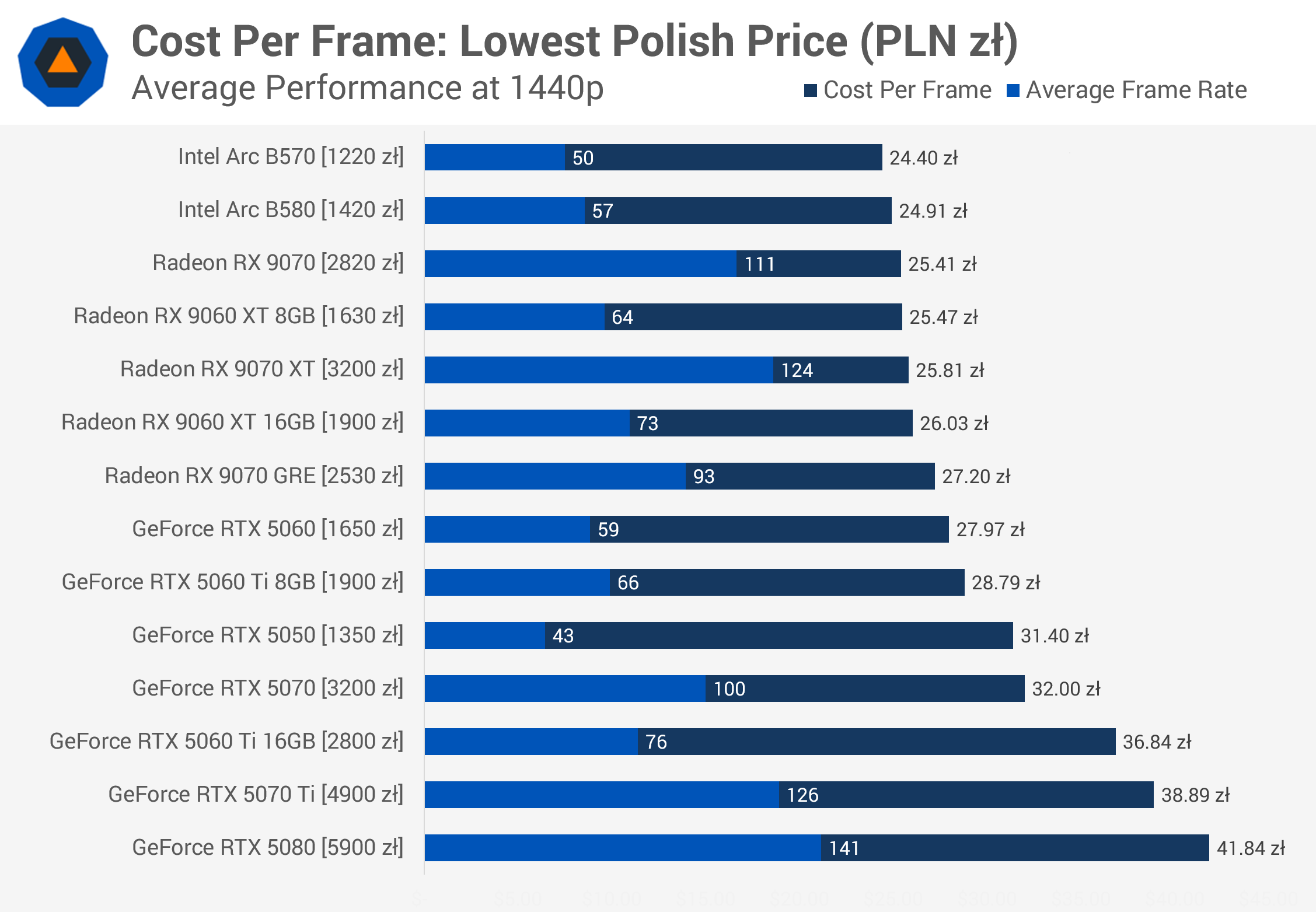
Poland looks very similar to the other European markets, even if the currency is different. Pretty much everything we said about GPU value in Germany applies here, and the general ordering of cards is nearly identical between the two regions.
The Arc B570 isn't quite as much of a standout in Poland, but Intel's Arc models still top the chart by a slim margin.
Brazil
Lastly, we have Brazil, where a few interesting things are happening. The RTX 5060 tops the chart for the first time, offering 5 to 8% better value than the RTX 5060 Ti 8GB and RX 9060 XT 8GB.
That's a reasonable position for a mainstream model, especially given that the RX 9060 XT 16GB isn't particularly good value in this region. The RTX 5060 is 16% cheaper per frame.
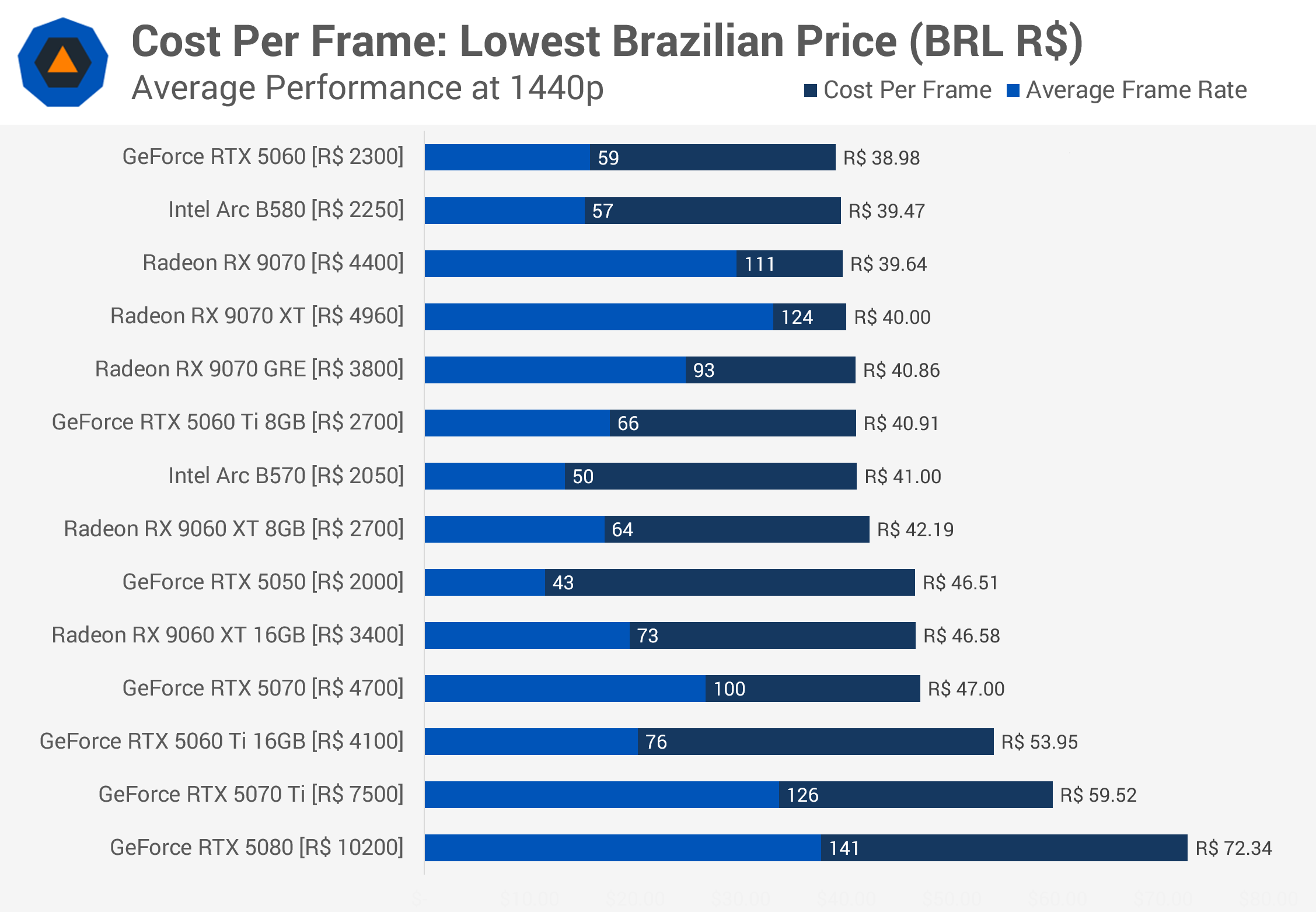
There are still sizable gaps between Radeon and GeForce in the upper parts of the market. The RX 9070 XT is 15% cheaper per frame than the RTX 5070 and 26% cheaper than the RTX 5060 Ti 16GB. There's an even larger margin to the RTX 5070 Ti, while the RTX 5080 is especially poor value here, particularly compared with its relative cost per frame in some European markets.
What We Learned: Nvidia Leaves the Door Wide Open for AMD
That's our look at graphics card value based on cost-per-frame data across a range of regions. While there are some outliers depending on the specific country, the overall trends are remarkably consistent: GeForce GPUs have increased in price more than Radeon GPUs over the past month, making AMD's lineup considerably more competitive.
The bad news for Nvidia, and good news for AMD, is that Radeon now dominates the higher-end segments of the market. The RX 9070 XT should be competing in roughly the same price range as the RTX 5070, while carrying around a 20% price discount relative to the RTX 5070 Ti. Instead, the 9070 XT is now more than 30% cheaper than the 5070 Ti in many cases, creating some enormous discrepancies in value.
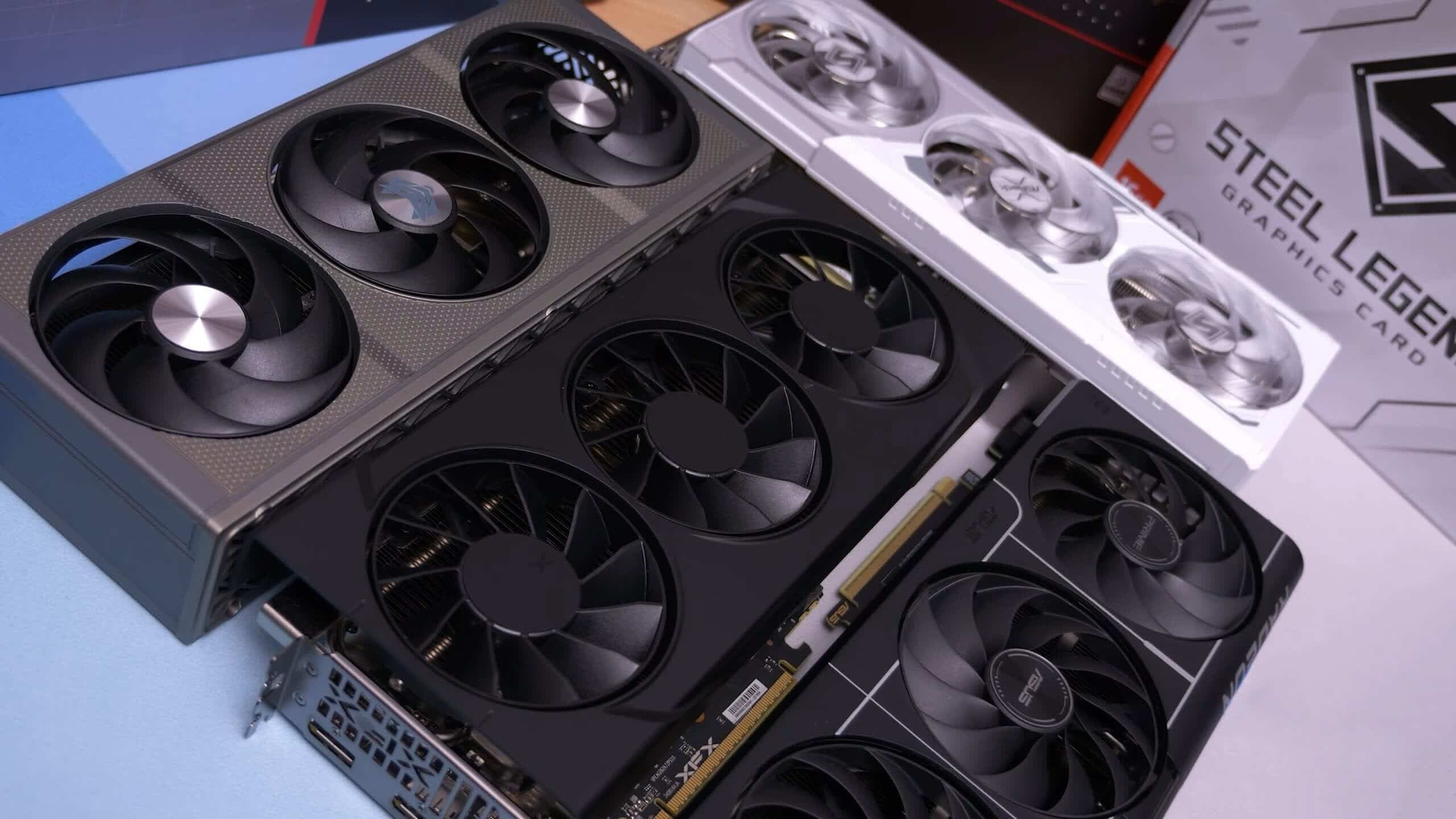
Depending on the region, either the RX 9070 XT or RX 9070 also tends to offer better value than the RTX 5070, and massively better value than the RTX 5060 Ti 16GB, which has somehow ended up in a similar price tier. The 5060 Ti 16GB should not be anywhere near this segment, but the ongoing memory crisis has pushed it to ridiculously high prices.
The mainstream and entry-level markets have been somewhat more resilient, and this is where the battle between Nvidia and AMD remains more competitive.
In many regions, the RX 9060 XT 16GB occupies a strong position simply because of its higher VRAM capacity, even when it doesn't offer a clear advantage in cost per frame.
There are some notable exceptions, however. In certain markets, the 9060 XT isn't particularly good value, and cards such as the RTX 5060 can make more sense.
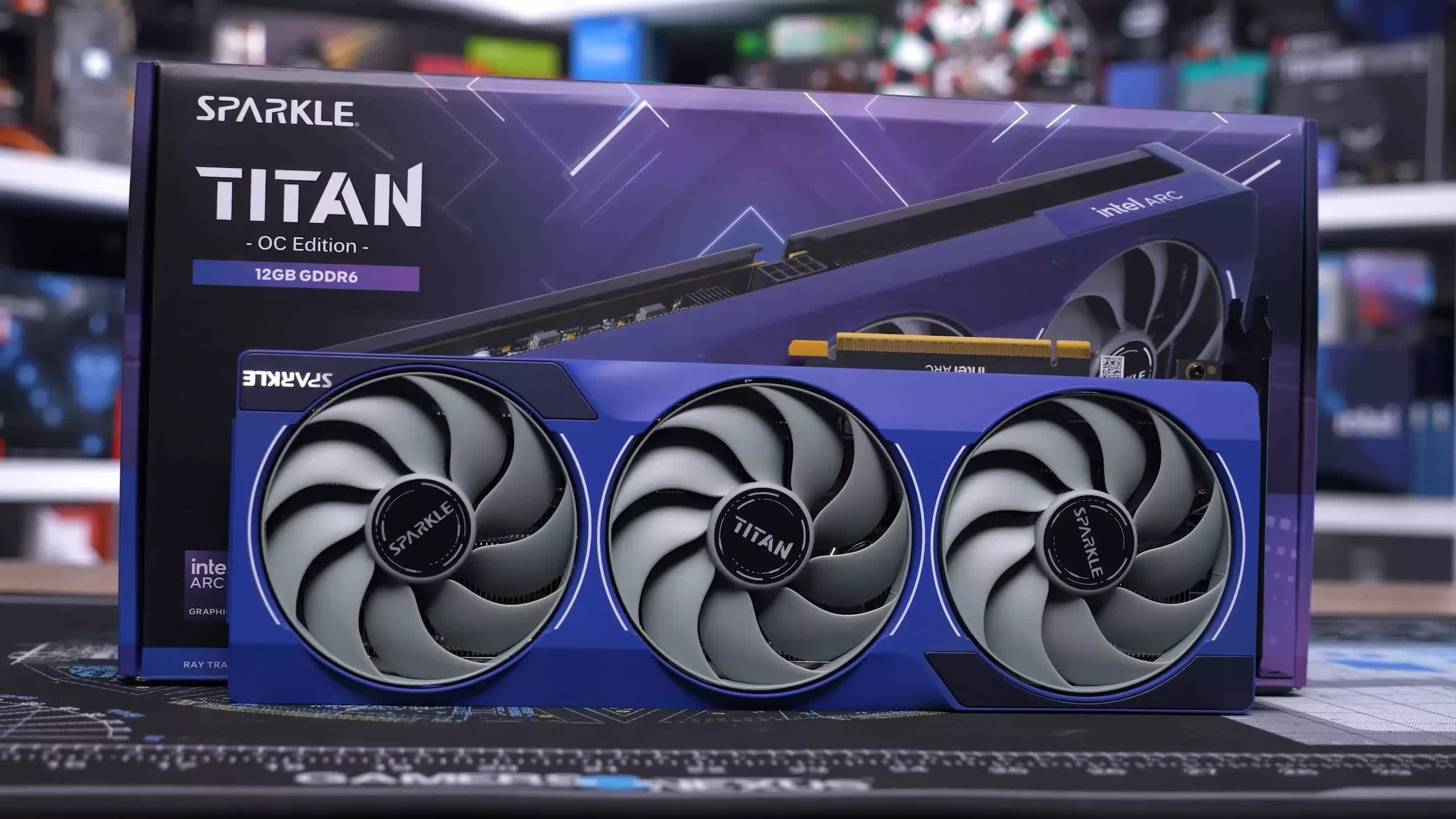
If we focus strictly on the cheapest models, mostly 8GB cards along with a few Arc GPUs, competition is at its strongest, and often there isn't much separating the GeForce and Radeon options.
Generally, we'd recommend spending more to get the RX 9060 XT 16GB because it's more capable today and should offer better longevity. But if you're trying to spend as little as possible, the RTX 5060 and RX 9060 XT 8GB are often competitive with one another.
The main model to avoid is the RTX 5050, which offers atrocious value in every single region we examined.
It's also possible that the value picture we're seeing today won't last very long. We expect Radeon GPUs to become more expensive throughout the remainder of 2026, which could weaken their position relative to GeForce. But we've also been hearing that GeForce pricing has further to climb, suggesting Nvidia's current prices may not have reached their ceiling either.
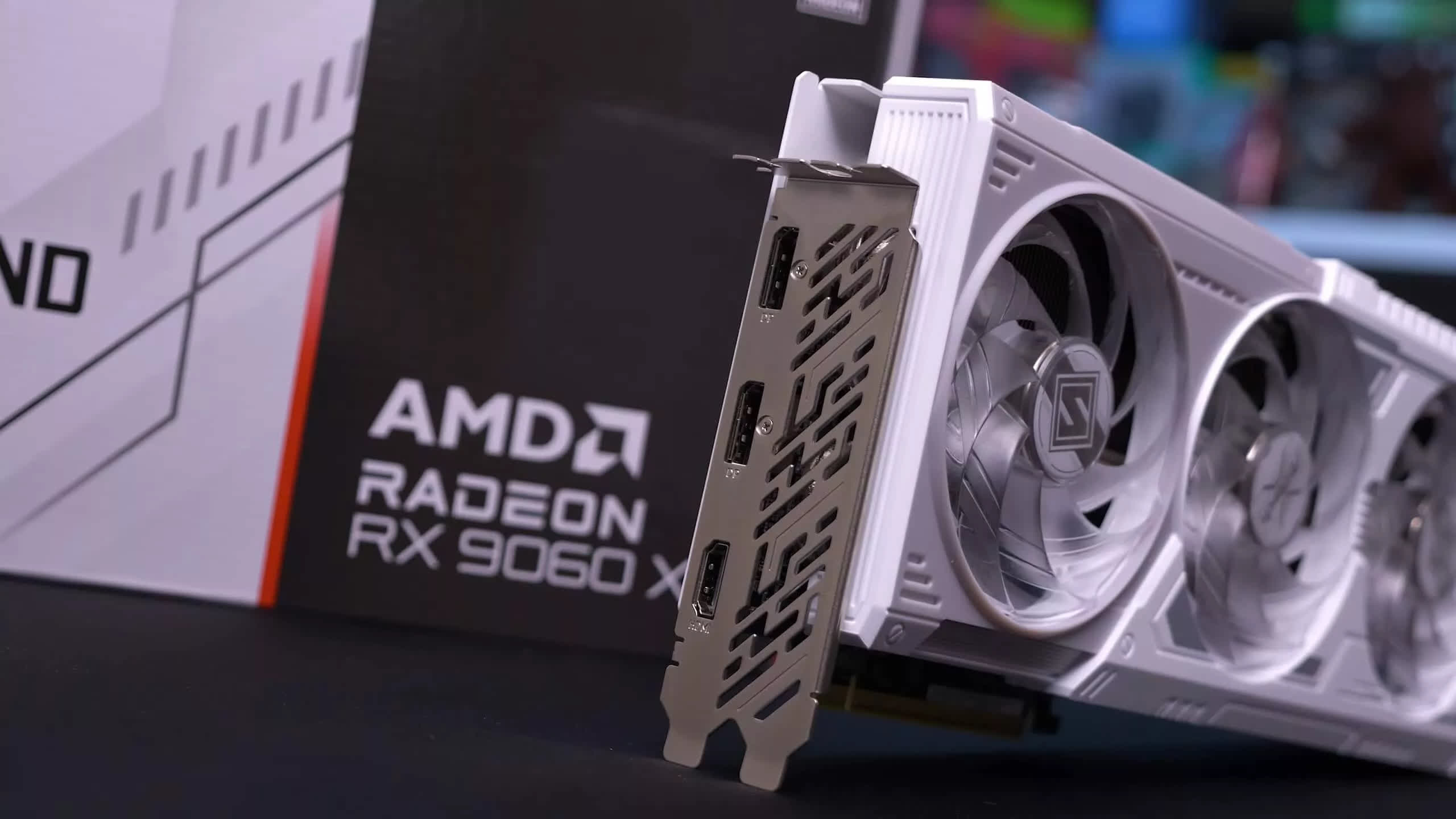
If both brands continue getting more expensive, the relative margins we're seeing today could remain largely intact. Exactly how that plays out is difficult to predict, but it's something we'll continue watching closely.
Ultimately, this cost-per-frame analysis is mostly an exercise in seeing how competitive each GPU lineup is under today's rather ugly market conditions. None of these GPUs are particularly well priced right now, and as things stand, we don't recommend buying a new graphics card unless you absolutely need one.
If you do need to buy, this data should help identify the least painful options. For everyone else, sticking with the GPU you've already got seems like the much better move right now.