
For the past couple of years, almost every major AI launch has followed the same script: a bigger model, better reasoning, a longer context window, smoother conversation. However, this month a startup called TypeSafe AI went the other way. It also matters that the founder of that startup, Diogo Almeida, worked at OpenAI on the instruction-following research (known as RLHF) that turned raw language models into ChatGPT.
Almeida's startup spent two years working in stealth mode and just recently received $40 million in funding.
What he's showcasing now is the company's first model, called "Jev." Unlike GPT and other chatbots, Jev can't write an email. It won't try to explain itself, and it has no chat window. What it does is make fast decisions, in about a tenth of a second, for a fraction of a cent. Almeida argues that chat was never the right tool for automation.
Post by @CompleteSkeptic
The problem with talking computers
Large language models do one thing at their core: they generate text, one token at a time, each word conditioned on the last. That's great when a human is on the other end. But with AI "agents" taking over, this seems to be a poor fit when the reader is another piece of software. That's the conundrum at this stage of AI: whether we like it or not, it's happening, and a growing share of it involves software talking to other software rather than to us.
But software doesn't want a paragraph. It wants a yes or no, a number, or a category. Today, developers who put AI inside an app ask an LLM a question and wait while it writes out an answer. Then they parse that text, validate it, and retry when the model goes off script. Every one of those words also costs money, since output tokens usually cost several times more than input.
Here is a 45-second illustration from developer Matija Sosic that captures the problem well...
An app asks whether an invoice is fraudulent. The LLM spends 8+ seconds typing out a sentence concluding the invoice looks legitimate. Jev instead answers in 0.1 seconds with three numbers: 7% fraud, 88% clean, 5% needs review. It gave up writing to get the speed. That trade is the whole product.
I'm not an AI expert and I'm looking at this as an interested outsider, trying to understand the basics and explain why it matters. Whether Jev turns out to be the future (or any other AI model, for that matter) or not, novel technology like this is what drives our interest as tech enthusiasts anyway.
What Jev actually does
Instead of a prompt, Jev receives the "state" of a situation and a set of pre-defined questions. That state can be a support ticket, a user's account history, or a snapshot of a game. There are three question types:
- Choice: pick one of up to 255 options.
- Score: rate something on a scale.
- Noul: TypeSafe's name for a yes/no answer.
Every answer comes with a probability, and all the questions are evaluated at once in a single parallel pass rather than written out word by word.
TypeSafe claims response times of 70 to 500 milliseconds, compared with anywhere from 3 seconds to several minutes for frontier LLMs. Pricing is $0.042 per million input tokens, and output is free because there's no text to meter.
Engineer Paarangat Rai offered perhaps the most useful framing, calling Jev "an AI-native if statement." Traditional code might flag every transaction over $10,000 for review. With Jev, the rule can instead be: if this behavior looks suspicious with more than 95% confidence, send it to a human. The hard-coded threshold becomes a judgment call, and the confidence score decides when a person steps in.
Why this matters
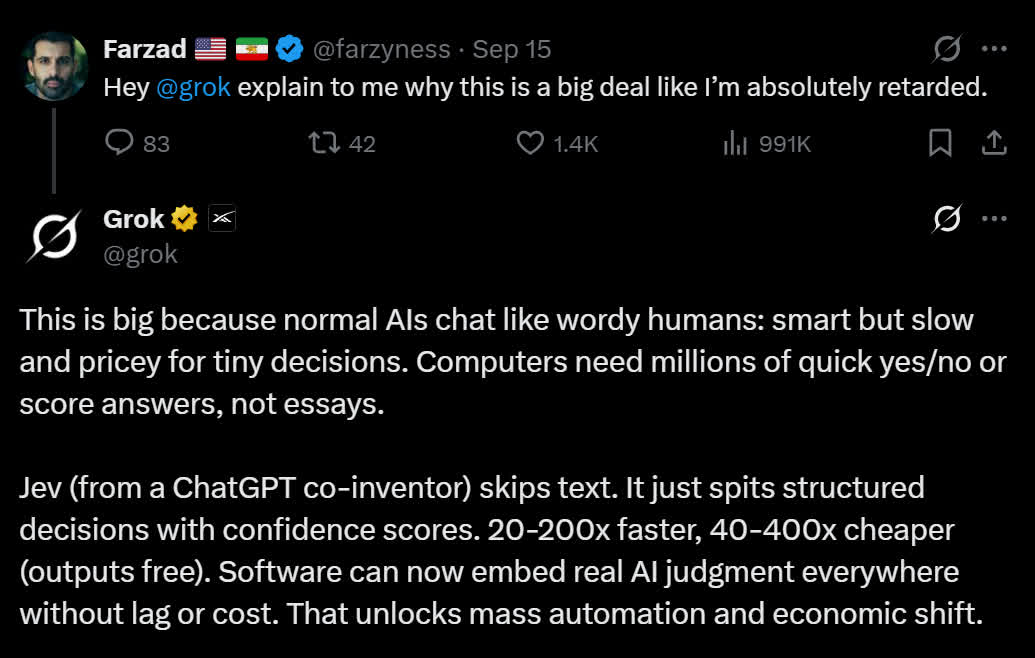
Most of the AI we interact with daily is not necessarily a chatbot. It's the invisible layer of decisions behind the apps we use: spam filters, fraud flags, support-ticket routing, content moderation, etc. Here's how 'chatty' Grok summed up the fuss. Computers need millions of quick judgments, not essays...
Speed also changes what AI agents can do. Anyone who has watched an AI browser agent crawl through a website knows the pain: every click is a multi-second call.
TypeSafe's own demos push the same point. One has Jev playing Doom at 10 decisions per second, which works out to roughly $7 an hour. It's reading a text description of the game state rather than pixels, though. In a third-party blitz chess match, Jev beat Anthropic's Fable 5.1 while massively down on material, simply because Fable burned through its clock thinking. OpenAI's GPT-6 Astra checkmated Jev in 18 moves. That's a latency result, not a chess one, but it shows what speed buys you.
The less flashy but possibly most important use is verification. At these prices, a developer can check every single output from a larger, smarter model before it reaches a user or triggers an action. That kind of oversight has been too slow and expensive to run on everything.
The trolley problem, 100 times
Then there's the demo that made people laugh and wince at the same time. Developer Alex ran Jev through the classic trolley problem 100 times: five people on the main track, one on the side track. Jev pulled the lever all 100 times, with 99% confidence each time. His caption joked that he'd trust Jev with his life...
Post by @The_Alex
One reply pointed out that a two-line if statement produces the same result offline for free. That's funny, and also the point. Consistency is a key selling point: ask a chatbot the same question twice and you may get two different answers.
But the demo also shows where responsibility actually sits. Jev only picks from the options someone wrote for it. Whoever designs the menu of choices, and sets the confidence threshold for acting, is making the real decision.
Read the fine print
Jev's launch drew a busy Hacker News thread, and the skepticism is worth taking seriously...
"Can't hallucinate" is a narrow claim. Jev can't return an answer outside the list it was given. It can't invent an "extremely high" risk level if the options are low, medium and high. But it can still confidently pick the wrong option.
The benchmarks are TypeSafe's own. The company skipped public leaderboards. Its workflow tests score models by agreement with the averaged answers of GPT-6 Astra and Fable 5.1, not against verified ground truth. By that measure, Jev reached about 67.8% agreement overall versus 74.1% for GPT-5.6 Sol. It came close on customer service (76% versus 78.3%) and fell well behind on invoice processing (61.8% versus 79.1%). The headline 193.6x speed and 444.6x cost advantages come from these same tests, and TypeSafe itself says they sit at the high end of real-world gains.
– Sarvagya Kulshreshtha (@sarvagya_kul) September 18, 2026
Independent testing is thin but encouraging. One early hands-on test ran 777 judgments on a writer's archive in under 0.7 seconds for about a quarter of a cent. In a smaller trial, Jev caught 6 of 7 planted writing flaws, versus all 7 for Fable 5.1, while running roughly 25x faster and 580x cheaper. That's a trade-off in quality, but a small one for many jobs.
Other notable limits: in its current early access version, Jev handles only text and structured data, not images, and TypeSafe hasn't published an architecture paper or parameter count.
The Jevons bet
The name of the model is its thesis. In 1865, economist William Stanley Jevons observed that more efficient steam engines didn't reduce coal use. They made coal cheap enough to use everywhere, and consumption soared. TypeSafe is betting that every order-of-magnitude drop in the cost of an AI decision will unlock far more uses than it saves.
That's not a sure thing. Plenty of people with access to AI tools still don't use them. But Jev isn't aimed at people. It's aimed at the billions of small, dull decisions software makes every day, most of which do not justify a more expensive LLM call.
– Kun Chen (@kunchenguid) September 18, 2026
There's an echo of an earlier breakthrough here. In 2017, the Transformer won by dropping sequential processing in favor of parallel attention, and it went on to power the chatbots Jev now positions itself against. Jev drops the very thing that made those models famous, writing, in exchange for speed.
Whether Jev is a real breakthrough or not, the bigger idea may be the one that sticks in the long term. The future of AI software might not be one giant model doing everything, but a slower, more thoughtful model for hard problems surrounded by fast, cheap deciders for everything else.