One of the standout stories in the games industry this last year has been the continued rise of indie hits. At a moment when development budgets just keep ballooning, it's a reminder that spectacle isn't the deciding factor – what ultimately matters is how fun a game is to play.
In the latest update to The Best PC Games (You Should Be Playing), we've expanded the list slightly to make room for a few more titles. The mix remains intentionally broad, spanning action adventures and RPGs, roguelikes, and even a surprise breakout-style hit. Most of these games will be familiar names. A handful may not be. And, as always, you probably won't agree with every single pick.

It's also worth noting that these new recommendations don't replace our earlier picks from previous editions. Many of those are excellent games not to be missed, and are now available at significant discounts, making them just as worthy of your attention now as before.
Turn-based triumph
Clair Obscur: Expedition 33

- Genre: Turn-based RPG
- Similar: Persona 5 Royal, Metaphor: ReFantazio, Lost Odyssey
- Graphics: Like being in an oil painting
- Gameplay: Turn-based combat with real-time inputs, party management, narrative-driven exploration
Who would have thought that an RPG from an indie developer with (mostly) turn-based fighting could become such a success. "Success" is putting it mildly: Clair Obscur: Expedition 33 has been a phenomenon winning no less than nine categories, including GOTY, at The Game Awards.
The game's story of a mysterious Paintress who conjures an annually decreasing number in the sky, causing everyone at that age to die, gives you hope that people haven't run out of creative ideas. The imagination used to weave this tale is something rarely seen in any medium.
Then there's the combat. While mostly turn-based, the real-time elements like timed dodges, parries, and attack inputs keep battles tense and engaging.
Creating your own builds for each character, selecting and assigning the best skills, Pictos, and Luminas so everything synergizes well, is a true highlight. Finding a seemingly perfect combination feels great, only for new options and weapons to appear and give you more toys to play with.
While the previously mentioned Dispatch's voice acting is great, Clair Obscur's is arguably even better. Combined with exceptionally good writing, this is one of those rare games that can be as fun to watch as to play. Oh, and it really does look like a painting brought to life.
There are a few rough edges. Some players may find the heavy reliance on timed inputs off-putting if they prefer more traditional turn-based systems, and the game's difficulty spikes can occasionally feel unforgiving, especially when facing multi-stage bosses. Exploration, while visually stunning, is sometimes linear, and a handful of side activities lack the same polish as the main campaign. Performance hiccups also crop up in a few later sections.
Clair Obscur: Expedition 33 is an extraordinary achievement. It's the kind of RPG that lingers in your mind long after the credits roll, and well-deserving of the slew of accolades it's received. With the free DLC now available, there's never been a better time to return to this stunning world.
Buy it from: Steam, GOG, Epic Games Store, Game Pass
Not all heroes wear capes
Dispatch

- Genre: Episodic adventure
- Similar: The Wolf Among Us, The Walking Dead, Life is Strange, most titles from Telltale Games
- Graphics: lovely cartoon style, like playing a Legend of Vox Machina episode
- Gameplay: Choice-and-consequence, narrative-focused, strategy and puzzle elements, optional QTEs
What sounds like a niche experiment: an episodic, Telltale-inspired blend of animated TV show, choice-and-consequence gameplay, and minigames has not only become a hit, but also one of the best games of the year.
If you've played The Wolf Among Us, Until Dawn, The Walking Dead, or any other narrative-focused title that gives you hard choices to make and little time to make them, you'll know what to expect for most of your time in Dispatch.
The story of former supervillains being managed by dispatcher Robert Robertson, himself an ex-hero, is part The Boys and part The Legend of Vox Machina. Critical Role's involvement is obvious; many scenes are laugh-out-loud hilarious, and there's lots of sexiness.
The story of Dispatch is what really sets it apart.
When not agonizing over choices, which makes up around 80% of the game, you'll be playing the part of dispatcher. It's your job to pick the best characters for the calls that come in, all while fighting against the clock. Do well, and your team members level up, gaining new stats and skills; fail too often, and there are consequences. There's also a hacking minigame that's more fun than it has any right to be.
The story of Dispatch is what really sets it apart. The cast, which includes big hitters like Aaron Paul and Jeffrey Wright, is wonderful, featuring the kind of performances actors don't always bring to games. There's one bit in particular that has more emotional impact than Sephiroth ramming his sword through Aerith.
Negative points are few and far between. It's only about 8 hours to complete all episodes (though it is just $30). And some people refuse to see this genre as anything other than an interactive TV show with some mobile-style games in it.
Ultimately, Dispatch is brilliant, with a cast of characters and a story that will stay with you long after you've finished. There's a reason it hit its three-year sales target in three months. Roll on season 2.
Buy it from: Steam
Don't mention the AI!
Arc Raiders

- Genre: PvPvE extraction shooter
- Similar: The Cycle: Frontier, Helldivers 2, Escape from Tarkov, The Division 2
- Graphics: Unreal Engine 5-powered prettiness, stylish retro-futuristic sci-fi, impressive effects, well optimized
- Gameplay: Third-person view, fast-paced shooting, scavenging, squad tactics, extraction-based objectives
Arc Raiders has had one of the strangest journeys to release in recent memory. Originally revealed as a co-op PvE shooter before pivoting mid-development into an extraction-style PvPvE experience, it could easily have ended up a confusing mess. Thankfully, Embark Studios has delivered something surprisingly cohesive: a stylish, fast-paced sci-fi shooter with enough audiovisual flair to stand out in a very crowded genre.
Set on a retro-futuristic version of Earth under constant threat from machine invaders, Arc Raiders' aesthetic is its biggest hook. Everything from the 70s-inspired tech to the synth-heavy soundtrack gives the world a distinct identity.
Matches are tense and often chaotic. You drop onto a war-torn landscape, scavenge for gear, take on ARC automated enemies, complete objectives, and try desperately to extract before another squad ambushes you. It's a formula we've seen before, but the robotic foes – some towering, some insect-like, all deadly – add a welcome layer of unpredictability.
The gunplay is punchy and responsive, with a focus on mobility. Sliding, vaulting, and boosting feel great, while the weapons, from magnetic rifles to improvised scatterguns, have that crunchy Embark sound design that always impressed in their tech demos.
Teamwork makes a huge difference: coordinated squads can bait Arc patrols into fighting other players, turn ambushes into opportunities, or pull off daring last-second escapes that feel ripped straight from a sci-fi heist movie.
Progression is surprisingly deep, too. Between loadout customization, gear rarity, and character perks, there's a lot of room to experiment. The environmental storytelling helps elevate each match beyond "just another extraction run." When everything clicks, Arc Raiders offers some of the most visually spectacular firefights you'll find around.
You can't talk about Arc without mentioning the AI-generated voice controversy that led to the infamous Eurogamer review. It's a decision many players felt was tone-deaf in an industry already dealing with layoffs and concerns over creative displacement. Embark later clarified and adjusted some elements, but the backlash lingered. Beyond that, Arc Raiders can suffer from uneven difficulty spikes, extraction camping remains a problem, and some objectives feel a bit too repetitive after long sessions.
Still, Arc Raiders is a striking and highly enjoyable experience, especially for players who love tense encounters with strong sci-fi leanings. It's visually gorgeous, mechanically polished, and capable of producing those memorable, chaotic moments that keep people coming back match after match.
Buy it from: Steam, Epic Games Store
Worth the wait
Hollow Knight: Silksong

- Genre: Metroidvania
- Similar: Hollow Knight, Ori and the Will of the Wisps, Blasphemous
- Graphics: Hand-drawn 2D art, fluid animation, atmospheric biomes
- Gameplay: Precision platforming, fast melee combat, boss-heavy progression, quests, exploration, upgrades
After years of anticipation, Hollow Knight: Silksong has finally arrived. Thankfully, Team Cherry somehow delivers a sequel that feels both familiar and different. Taking control of Hornet, the princess-knight of Hallownest, you're thrust into the kingdom of Pharloom: a towering, labyrinthine world brimming with traps, secrets, and the haunting beauty the series is known for.
Traversal is a joy in Silksong. Hornet moves with a grace the Knight never had, sprinting, sliding, climbing, and chaining acrobatic moves that make the world feel more alive and responsive. Combat follows suit: it's faster, more expressive, and packed with brutally intense encounters that test your reflexes and mastery of her expanding toolset.
Boss fights are extraordinary, blending gorgeous animation with demanding patterns and that trademark sense of triumph when you finally overcome them. Pharloom itself is a work of art, from shimmering cities to fungal swamps and gilded cathedrals, each packed with memorable NPCs, branching quests, and secrets that encourage obsessive exploration.
There's also a much heavier emphasis on quests and progression than before, with side characters offering storylines that twist and expand as you delve deeper into Pharloom. Crafting, tools, and new Silk-based abilities give you meaningful freedom in shaping how Hornet handles. And like the original, the environmental storytelling shines with hints, symbols, and cryptic conversations slowly assembling a larger narrative beneath Silksong's vibrant surface.
Some players may find the higher baseline difficulty a bit overwhelming, especially early on when Hornet's mobility comes with a steeper learning curve. A few areas lean heavily into platforming gauntlets that might frustrate those who preferred the slower, more methodical pace of the first game. And while the quest system adds depth, it can occasionally feel directionless, sending you wandering without clear breadcrumbs.
Hollow Knight: Silksong is a triumph – a richer, faster, more ambitious evolution of one of the greatest indie games ever made. It captures everything that made Hollow Knight special while carving out a distinct identity of its own. The wait was long, but the result is extraordinary.
Peak destruction
Battlefield 6

- Genre: Multiplayer-focused FPS
- Similar: Previous Battlefield games, Call of Duty series
- Graphics: Pretty typical of the modern genre, great explosions, well optimized
- Gameplay: Large-scale multiplayer combat, class-based teamwork, vehicle warfare, objective-focused modes, small single-player campaign
When EA and DICE announced they were going "back to basics," few expected the series to feel this revitalized. After years of identity crises, undercooked launches, and feature creep, Battlefield finally remembers what made it so loved in the first place: massive maps, teamwork that actually matters, and explosions – lots of explosions.
Battlefield 6 is essentially a modern reinterpretation of Battlefield 3 and 4's DNA. Conquest and Breakthrough remain the stars of the show. Maps are tighter and more focused, avoiding the "empty fields" problem that plagued earlier games. Infantry, armor, and aircraft all have defined roles again, so matches feel structured rather than chaotic for the wrong reasons. The pacing is superb, and minute-to-minute combat is incredibly satisfying.
The gunplay is the best the series has seen in over a decade. Recoil patterns are readable, weapons feel weighty without being sluggish, and the sound design, especially with a decent headset, is phenomenal.
Urban environments crumble during lengthy firefights, helicopters roar overhead, and every shot has that punchy Battlefield feel that fans have been missing. The class system is back, too, bringing genuine teamwork and synergy instead of the loose specialist soup that angered the community last time around.
The usual Battlefield issues do remain. Launch week had its fair share of bugs – not quite Battlefield 2042-level disastrous, but enough to cause frustration. Vehicle balancing still swings wildly from patch to patch. And while matchmaking is much better, you'll still occasionally experience that classic Battlefield phenomenon of your team disappearing when you need them most. The single-player campaign is pretty lackluster, too.
Ultimately, Battlefield 6 is the franchise's best entry in years and a genuine return to form. It delivers the chaos, teamwork, spectacle, and "only in Battlefield" moments that fans have been craving. If DICE can maintain consistent updates, this will become the series' new benchmark.
Buy it from: Steam, Epic Games Store
Veni, vidi, vici
Anno 117: Pax Romana

- Genre: City-builder sim
- Similar: Anno series, Banished, Europa Universalis V, Manor Lords, Tropico 6
- Graphics: Lush Roman landscapes, detailed cities, vibrant animations
- Gameplay: Real-time strategy, city planning, resource management, politics, trading
After the wonderful Anno 1880, Anno 117 shifts the scene to the height of the Roman Empire. Instead of the usual colonial or industrial backdrops, you're managing the sprawling logistics that hold an ancient empire together. It feels fresh while still unmistakably Anno.
From the moment you establish your first settlement, the game's strengths shine through. Production chains are as intricate and satisfying as ever, but now wrapped in a layer of Roman bureaucracy: governors to appoint, provinces to stabilize, and political pressures to navigate.
The district system in cities allows for much more creative planning than past titles, giving you a real sense of shaping a living metropolis. Watching your settlements grow from muddy encampments into bustling Roman towns is genuinely spectacular.
Anno 117 is soaked in atmosphere, from the sunbaked Mediterranean landscapes and the roadside shrines, to the amphitheaters and forums packed with citizens.
Naval trade plays a more prominent role, too, with shipping lanes that stretch across gorgeous blue seas and open the door to lucrative but risky trade deals. The campaign is surprisingly strong, weaving historical fiction with familiar Anno economic depth to keep you engaged for dozens of hours.
When everything is running smoothly, Anno 117 is dangerously addictive. You'll tell yourself you're only adjusting wheat production before going to bed...
When everything is running smoothly, it's dangerously addictive. You'll tell yourself you're only adjusting wheat production before going to bed, only for the sun to rise outside the window as your province doubles in size and you're knee-deep in marble shortages because you expanded too aggressively.
Anno 117 launched with tons of bugs, including pathfinding glitches, UI overlaps, odd resource miscalculations, and performance drops on larger maps. The game's use of AI-generated art in some UI assets also sparked plenty of controversy, with players arguing that a premium title shouldn't lean on AI tools – especially when the series has historically been celebrated for handcrafted detail. While Ubisoft addressed some concerns, the backlash hasn't fully faded. A handful of balance quirks and the occasional difficulty spike also crop up during long campaigns.
Anno 117 is a fantastic addition to the series and one of the most engrossing strategy titles in some time. Its Roman setting is inspired, its mechanics are deep and rewarding, and its "just one more upgrade" loop is as potent as ever. Once the rough edges are patched out, this could easily rank among the very best Anno games.
Buy it from: Steam, Epic Games Store
Roguelite perfection
Hades 2

- Genre: Action-focused roguelike
- Similar: Hades, Dead Cells, Rogue Legacy 2, Risk of Rain series
- Graphics: Isometric, vivid and cartoonish style that looks beautiful
- Gameplay: Fast melee/shooting combat, replay-focused design
After what felt like an unending early access period, Hades 2 fully delivers on its promise to expand on what made Supergiant's acclaimed God-themed roguelike such a standout.
Much like its predecessor, the Hades 2 thrives on sharp, satisfying combat. This time, it's bigger, bolder, and more complex. Every run feels kinetic, with a dazzling array of weapons, boons, and godly powers that let you build wildly different playstyles from one attempt to the next.
The writing, voice acting, and character cast remain among the best in the genre, bringing mythic figures to life with charm, voice, and unexpected humor.
Hades 2 offers stronger strategic choices between runs, deeper weapon progression, and a richer overworld to explore when you're not fighting through the Underworld's shifting corridors. New systems like animal companions and long-term upgrades add meaningful layers of decision-making, and the way story threads weave into your repeated deaths – advancing character arcs while still letting you feel consistent progress – is masterful.
Visually, it's stunning: every biome is distinct, every boss encounter memorable, and the soundtrack continues to set the gold standard for action roguelikes.
Some runs can feel longer than necessary, particularly once you're chasing specific gear or goals, and the increase in systems, while rewarding, can be a bit overwhelming to newcomers compared with the more streamlined original. There are moments where balancing feels uneven across certain weapons or combinations, leading to runs that feel either too easy or frustratingly punishing.
Hades 2 is a triumphant follow-up that takes an already excellent formula and expands it in nearly every meaningful direction. It's easily one of the most engaging, replayable roguelikes of the decade, and a must-play for fans of the genre.
Buy it from: Steam, Epic Games
Beastly
Dying Light: The Beast

- Genre: Action RPG
- Similar: Dying Light 2, Dead Island 2, Mirror's Edge
- Graphics: Atmospheric lighting, detailed decay, familiar but polished environments
- Gameplay: First-person, parkour traversal, open-world, melee combat, choices, crafting, co-op options
The zombie bashing, parkour-filled Dying Light series has been around for over a decade now, with Dying Light 2 Stay Human proving particularly successful. The Beast was originally supposed to be a DLC pack for the second game, but don't let that put you off: it's great fun – as illustrated by a whopping 92% positive rating from Steam user reviews.
With The Beast, Techland has doubled down on the series' staples of speed, brutality, and verticality, throwing you into a new, more compact location teeming with infected, renegades, and environmental hazards.
Once again, you're sprinting across rooftops, grappling through skylines, dive-kicking zombies off ledges, and chaining parkour flows like you're auditioning for some post-apocalyptic Cirque du Soleil.
Combat feels sharper than ever. The Beast introduces new mutated enemy types that force you to constantly shift strategies, making every encounter feel unpredictable. Enhanced melee animations make strikes feel weighty, especially when you're shredding through crowds with improvised weapons or using your new Fury abilities to bulldoze enemies with supernatural strength. There's a feral, frantic energy to the whole experience that makes even basic scavenging runs exciting.
The story, while not the game's main selling point, is surprisingly engaging. It takes place after the events of Stay Human and follows the consequences of a dangerous new evolution of the infection. The writing is tighter, the pacing brisker, and the missions more varied. There's also more moral ambiguity than before, with choices that meaningfully shape how certain characters and factions see you.
The Beast does reuse a fair amount of assets from Dying Light 2, which some players feel makes parts of the world look too familiar. A few side missions fall into repetitive patterns, and despite multiple patches, occasional bugs and jank can rear their heads, including floating zombies, clipped animations, and the odd physics anomaly. There are also players who argue that the expansion-turned-standalone approach makes it feel less substantial than a full sequel.
Dying Light: The Beast is a blast to play and a reminder of why this series continues to thrive. It's fast, punchy, entertaining, and packed with moments that make you grin as you catapult yourself over shambling hordes. If you enjoyed either of the first two games, this is an easy recommendation.
Buy it from: Steam, Epic Games Store, GOG
A knight's tale
Kingdom Come: Deliverance II

- Genre: Action RPG
- Similar: Kingdom Come: Deliverance, Mount & Blade II: Bannerlord
- Graphics: Lush medieval landscapes, grounded realism, detailed environments
- Gameplay:First-person melee combat, survival systems, branching quests, reputation, historical role-playing
With Kingdom Come: Deliverance II, Warhorse Studios doubles down on the historical realism that made the original so distinctive. Set once again in 15th-century Bohemia, the story continues Henry's journey in a world that feels (sometimes too) authentic – from muddy villages and dense forests to the politics, class struggles, and brutal violence of medieval life.
It's a game that asks you to slow down, pay attention, and live in its world rather than simply conquer it.
Combat is deliberately challenging, but it's also far more approachable than in the first game. Swordplay still emphasizes positioning, stamina, and directional strikes, yet improved animations, clearer feedback, and smarter enemy behavior make fights feel more intuitive than before.
Outside combat, Deliverance II shines: survival mechanics, reputation, crime, dialogue checks, and skill progression all intertwine to create a world that reacts meaningfully to how you behave. Even simple tasks such as eating, sleeping, and traveling add to the sense of immersion.
The world is large, with towns that feel alive, quests that often avoid clear moral binaries, and side stories that rival the main plot for quality. The writing is sharp, performances are strong, and there's a better balance between historical authenticity and engaging storytelling than before. It's still dense and methodical, but it's also more confident in guiding players through its systems without compromising its identity.
Deliverance II remains intentionally slow-paced, which will put off players looking for instant gratification. Combat can still feel unwieldy in chaotic encounters, and despite improvements, occasional jank – from animation oddities to AI hiccups – crops up. The sheer number of systems can be overwhelming early on, and the realism-first approach means convenience often takes a back seat to authenticity.
At its heart, Kingdom Come: Deliverance II is a brilliant, deeply immersive sequel that refines its predecessor without abandoning what made it special. It's demanding, absorbing, and refreshingly different from most modern RPGs. A must-play for players who value realism, role-playing depth, and historical texture.
Buy it from: Steam, Epic Games Store, GOG
The spacer's choice
The Outer Worlds 2

- Genre: Action RPG
- Similar: The Outer Worlds, Starfield, Atomfall, Avowed, modern Fallout
- Graphics: More pretty than stunning
- Gameplay: First-person shooter, choice-and-consequence, character building, optional stealth
Obsidian's original Outer Worlds promised us Fallout: New Vegas in space, and while it was nominated for several awards (and winning some) it didn't capture that same magic or the desire to explore and see what's out there. With the sequel, Obsidian has made an RPG that's a lot closer to what we were expecting.
The Outer Worlds 2 doesn't reinvent the wheel, but that isn't a bad thing. From the get-go, you select your character's background, traits, skills, and specializations, which can dictate the best way to play while opening up unique dialogue options – the character building is one of its best elements.
The game itself offers plenty of fun. There are different ways to tackle quests, with plenty of choice-and-consequence options on offer. Combat can be a blast as skills directly affect your particular style – there are a ton of cool weapons, too, all of which can be modded in various ways. Exploration is rewarding, and companions, who are great additions rather than annoying afterthoughts, have their own special abilities that you can activate. The whole thing's quite funny, too.
Flaws are an interesting new mechanic. Based on the way you play, you are occasionally offered a huge buff at the expense of what can be a major disadvantage.
To reiterate, the biggest problem with Outer Worlds 2 is that it doesn't do much to stand out from the crowd. But it's certainly better than the likes of Starfield. It can also be a bit janky. Enemy AI is sometimes off, and melee weapons could be better. Nevertheless, Outer Worlds 2 is still a very good game. If you liked the first one and similar titles, you'll almost certainly enjoy it.
Breakout on crack
Ball x Pit

- Genre: Roguelite action
- Similar: Peglin, Vampire Survivors, Breakout-likes with progression
- Graphics: Vibrant, retro-esque 2D
- Gameplay: Physics-based ricochet combat, roguelite progression, settlement upgrades, buildcrafting
Every once in a while, a game takes a familiar genre and mutates it into something completely unexpected. Ball x Pit does exactly that, transforming the humble brick-breaker into a frantic roguelite where fusing balls, bouncing projectiles, and chaotic physics form the backbone of every run.
At its core, Ball x Pit is all about diving into a monster-filled pit, blasting enemies with ricocheting spheres, and collecting the resources you'll need to grow stronger. Between expeditions, you return to a little settlement that slowly grows into a bustling hub, unlocking new characters, upgrades, and starting conditions. The game constantly finds new ways to twist its own formula, throwing in wild ball modifiers, unpredictable enemy types, and randomized challenges that force you to rethink your build on the fly.
Early encounters see you carefully lining up shots, but before long you're juggling multiple fused balls that split, explode, charm enemies, or bend around corners in ways that feel absurdly satisfying.
Despite all the chaos, Ball x Pit has a clear, clever structure underpinning it. The progression is meaningful, the unlocks feel worthwhile, and there's genuine buildcrafting here: you'll discover combos and synergies that make certain runs feel hilariously overpowered. It's also very charming.
Some long play sessions can feel repetitive, especially when luck dictates how quickly you can assemble a strong build. A few enemies and modifiers aren't as fun to fight, and certain runs can be over before they've had a chance to develop. There are also moments where the chaos becomes too... well, chaotic, making it hard to read what's happening on screen.
Ball x Pit is one of most inventive indie action games we've played in a while, it's a wildly entertaining fusion of arcade and roguelite design. It's endlessly playable, enormous fun, and as addictive as crack cocaine. It's also cheap.
Buy it from: Steam, Epic Games
For Democracy!
Helldivers 2
- Genre: Squad-based shooter
- Similar: Earth Defense Force 6, Darktide, Vermintide 2
- Graphics: Detailed, impressive environments, works on wide variety of GPUs
- Gameplay: Third-person (first-person with some weapons), multiplayer co-op-focused
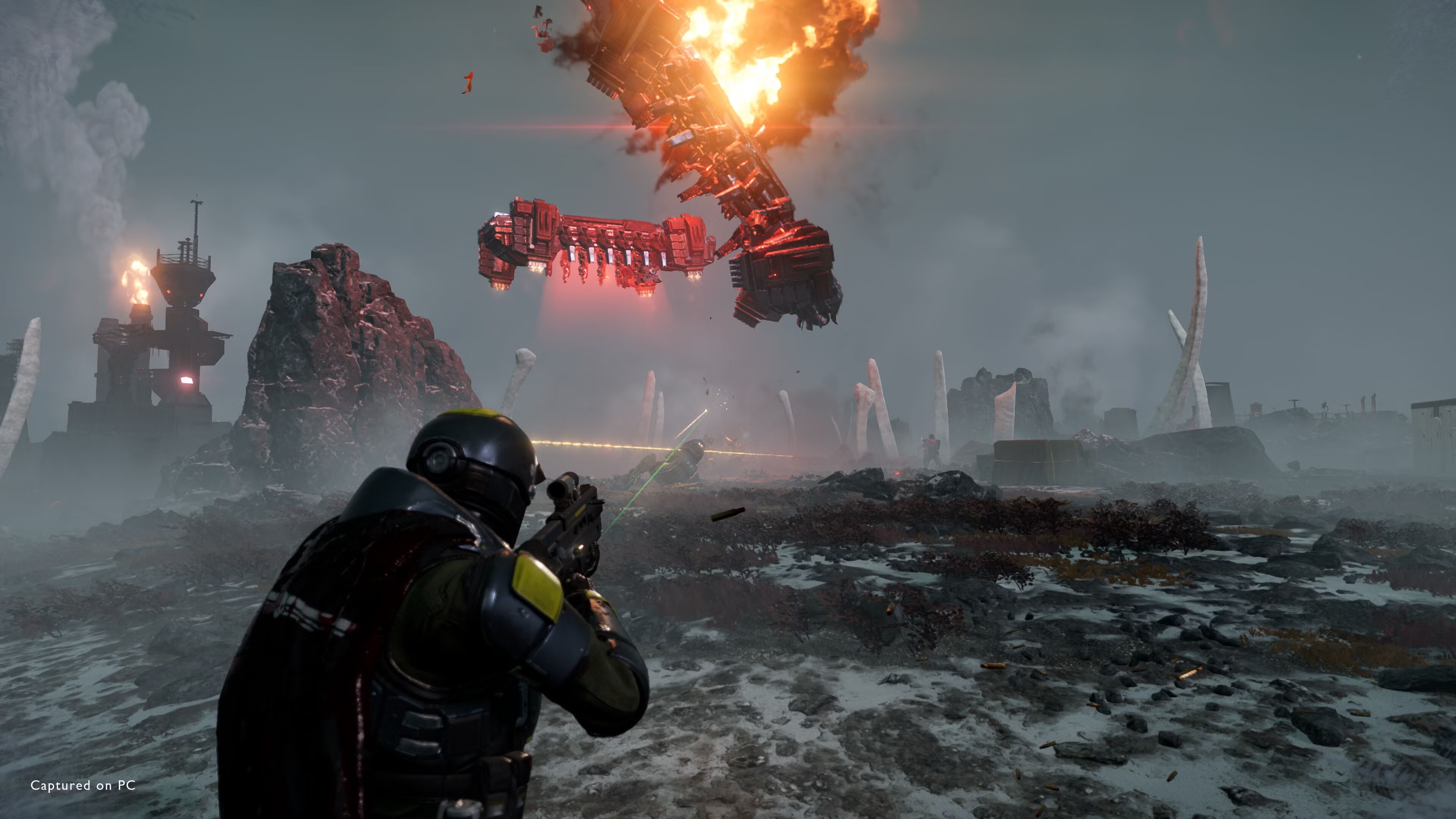
Few games have been as much of a revelation as Helldivers 2. Heavily inspired by Starship Troopers, this cooperative squad-based shooter blends intense, strategic gunplay with darkly humorous sci-fi storytelling.
Helldivers 2's missions are designed for four-player human co-op, encouraging players to specialize in different roles and work together. Communication and coordination are essential, especially with the game's infamous friendly-fire mechanic – one wrong move, and you could accidentally take down your own squad.
The arsenal of weapons and "Stratagems" (powerful call-ins like airstrikes and supply drops) is incredibly satisfying to use, giving players a wide array of tactical options. Whether calling down a mech suit, deploying a turret, or using a supply beacon, players must strategize their loadouts based on the mission and alien threats they face. The diversity of enemies and biomes keeps gameplay fresh, requiring different tactics and making each mission feel unique.
Graphically, Helldivers 2 impresses with detailed alien environments and explosive effects that make each battle feel immersive. However, the difficulty spikes can be punishing, and some players may find the challenge frustrating without a well-coordinated team. Additionally, a few technical issues persist.
With new updates arriving all the time, Helldivers 2 is a challenging, addictive, and engaging experience that rewards teamwork and strategy. With its blend of tactical depth, humor, and explosive action, it's a must-play for fans of the genre.
Buy it from: Steam
Honorable Mentions
Split Fiction
Split Fiction is unarguably one of, if not the, greatest couch co-op games ever made. The work that has gone into creating its multi-genre worlds, inventive puzzles, and breathtaking visuals should be endlessly applauded. There's even an upcoming movie adaptation. It's been out for a while now, but it's still absolutely worth playing, especially if you're looking for a great game to enjoy with your significant other.
Marvel Rivals
Marvel Rivals has been one of year's biggest surprises: a hero shooter that not only survived the genre fatigue but genuinely revitalized it. Fast, flashy, and packed with inventive team synergy mechanics, it delivers the kind of comic book chaos fans have been waiting to see for a long time.
Doom: The Dark Ages
Doom: The Dark Ages is a brutal reimagining of id Software's modern Doom formula, swapping neon sci-fi for a grim medieval aesthetic. It missed the top list not because of quality, but simply because it's an older release and most fans have already experienced its gloriously violent combat loop. Even now, it remains a relentless, exhilarating shooter that proves Doom's core design is timeless.
Europa Universalis 5
Europa Universalis 5 is Paradox at its most ambitious, pushing its grand-strategy formula into deeper, denser, and more historically rich territory than ever. From revamped diplomacy and dynamic population systems to far more reactive nations, it's a time-sink masterpiece for those who love shaping centuries of global history. Of course, this kind of sprawling, number-heavy strategy experience isn't for everyone.
Dropped from the list (great, but had to make room for others)
You can also check out previous editions of the Best PC Games for more awesome titles...