Explainer: L1 vs. L2 vs. L3 Cache
Every single CPU found in any computer, from a cheap laptop to a million-dollar server, will have something called cache. It must be important, otherwise why would it be there? But what does cache do?

Every single CPU found in any computer, from a cheap laptop to a million-dollar server, will have something called cache. It must be important, otherwise why would it be there? But what does cache do?
Wi-Fi is set to get better and faster. While plenty of routers are already available with chips using draft specifications, 802.11ax Wi-Fi was not finalized until late 2019, ushering in a wave of updated devices touting new wireless capabilities that will contribute toward next-generation networks with more speed and less congestion.

Nvidia has been making graphics chips that feature extra cores, beyond the normal ones used for shaders. Known as tensor cores, these mysterious units can be found in thousands of system, but what exactly are they and what are they used for? Today we'll explain what a tensor is and how tensor cores are used in the world of graphics and deep learning.

Every once in a while, a video game is made that becomes part of the industry's history. For PC gamers, there's one title that's almost legendary thanks to its incredible, ahead-of-its-time graphics and ability to grind PCs into single digit frame rates. Join us as we take a look back at Crysis and see what made it so special.

Machine learning (ML) is the study of computer systems that automatically improve with experience, a hot topic in the last few years, but a concept that's been around for decades. IBM programmer and AI pioneer Arthur Samuel coined the term "machine learning" in 1952.

The vast majority of visual effects you see in games today depend on the clever use of lighting and shadows – without them, games would be dull and lifeless. In this fourth part of our deep look at 3D game rendering, we'll focus on what happens to a 3D world alongside processing vertices and applying textures. It once again involves a lot of math and a sound grasp of the fundamentals of optics.

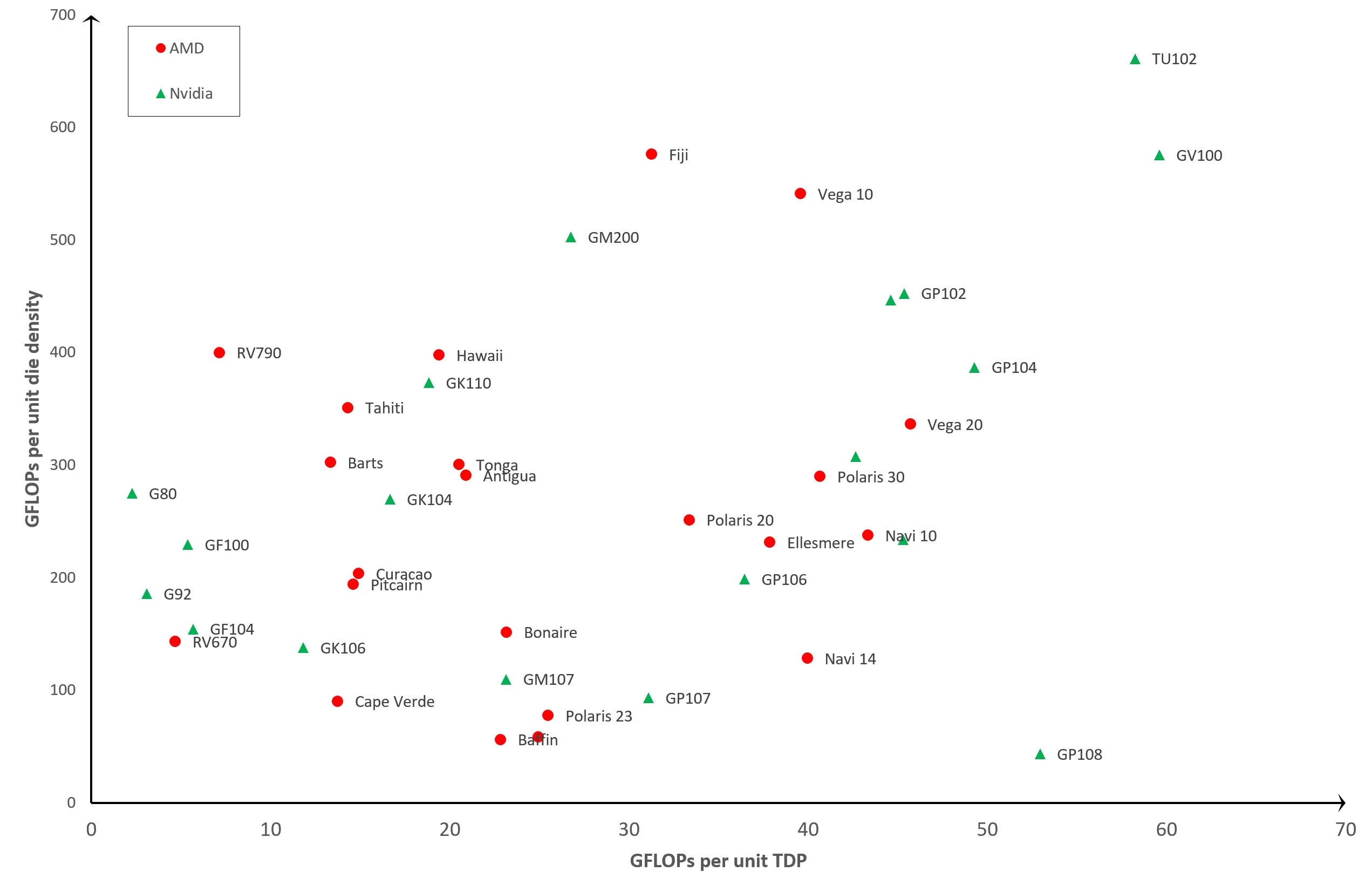
The first 3D graphics cards appeared 25 years ago and since then their power and complexity have grown at a scale greater than any other microchip found in a PC. In going from one million to billions of transistors, smaller dies, and consuming more power, the capabilities of these behemoths is immeasurably greater, but what can we learn about efficiency?
Video game physics are something that we often take for granted. Programming physics into a game can be as simple as one or two routines, or as complex as requiring a separate physics engine to handle the computations. In this article we'll delve into the specifics of rigid body and soft body physics in games.

Inside the latest graphics cards lies a large graphics processor, packed with billions of transistors, all running at clock speeds unthinkable a decade ago. Welcome to our architectural comparison of the newest GPUs from AMD and Nvidia.

In this third part of our deeper look at 3D game rendering, we'll be focusing what can happen to the 3D world after the vertex processing has done and the scene has been rasterized. The majority of the visual effects seen in games today are down to the clever use of textures – without them, games would dull and lifeless. So let's get dive in and see how this all works!

In this second part of our deeper look at 3D game rendering, we'll be focusing what happens to the 3D world after all of the vertex processing has finished. We'll need to dust off our math textbooks again, grapple with the geometry of frustums, and ponder the puzzle of perspectives. We'll also take a quick dive into the physics of ray tracing, lighting and materials – excellent!

In this first part of our deeper look at 3D game rendering, we'll be focusing entirely on the vertex stage of the process. This means dragging out our math textbooks, brushing up on a spot of linear algebra, matrices, and trigonometry – oh yeah!

Despite continuous improvements, processors haven't had industry shifting advancements for a long time. Yes, transistors are smaller, chips have gotten faster, and performance has increased hundredfold, but we're starting to see diminishing returns... learn what 3D integration, FPGAs, and near memory computing are all about.

In this third installment we explore how the physics of how transistors work, how their individual components are built in silicon, and how they are connected to create useful circuits and chips. How do you transform a pile of sand into an advanced processor? Let's find out.

Now that we know how processors work at a high level, it's time to dig inside to understand how the internal components are designed. In part 2 we'll discuss transistors, logic gates, power and clock delivery, design synthesis, and verification.

#ThrowBackThursday Today we're addressing one of the most frequently asked questions we see about PC gaming: how many frames per second do you need? Should you be running at the same refresh rate as your monitor's, say 60 FPS on a 60 Hz display, or is there a benefit to running games at a much higher frame rate than your monitor can display, like say, 500 FPS?

Heat is an inevitable byproduct of work. Heat is also prevalent in electronics, and when it comes to graphics cards you can manage it using passive cooling, fans and even water. But when these solutions aren't working, your GPU has one more way to beat the heat: thermal throttling.

Best known as the immutable database that runs underneath cryptocurrencies like Bitcoin and Ethereum, blockchain is poised to play a critical role in every industry imaginable as businesses seek ways to cash in on the distributed ledger technology's promise of enabling a "trustless" consensus to validate transactions.

Microsoft is set to release Windows 10 on July 29th and users of current versions of the operating system will get an upgrade free of charge. So where's the confusion? Microsoft has sent mixed signals (more than once) and speculation has built on top of that about who gets the free upgrade and who doesn't, if Insiders get a free pass or not. Here's an overview of the different upgrade paths to Windows 10 that explains it all.
